
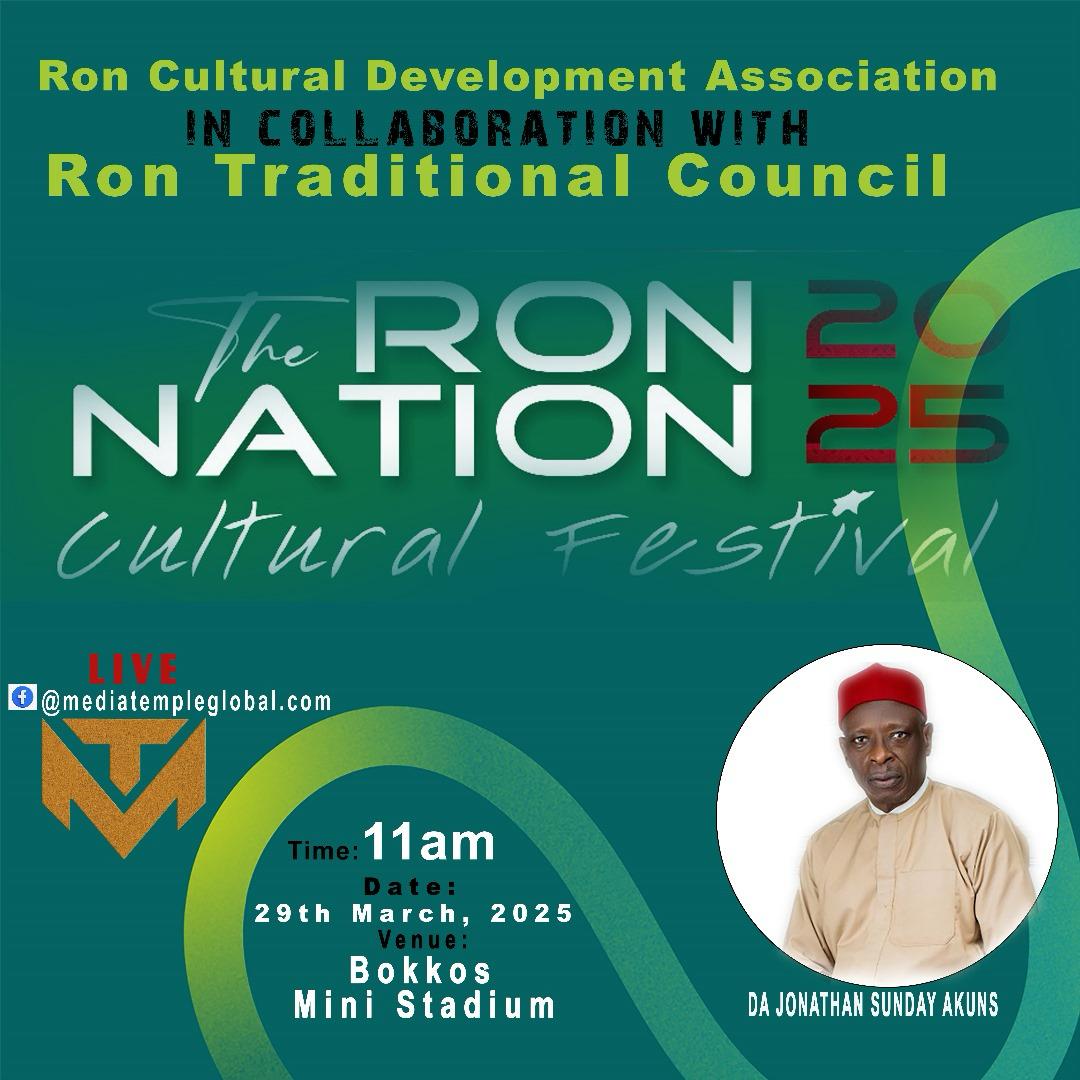
Being a Paper presented at the Ron Nation 2025 Cultural Festival, Bokkos
29th March, 2025
Macham Mangut, Ph.D.
The Executive Governor of Plateau State, Distinguished Members of Senate and House of Representatives, Honourable Minister, the Executive Chairman of Bokkos Local Government, Chairmen and Chair Lady of this remarkable occasion, the Ngolong Ngas, Royal Fathers, Esteemed Guests, and good people of the Ron Nation,
It is both an honour and a privilege to stand before you today as we gather to celebrate our shared heritage, our collective history, and our bright future as one Ron people. I extend my heartfelt gratitude to the Ron Cultural Development Association for inviting me as a guest speaker at this august occasion.
To start our discussion, let us briefly reflect on the origin of the name Ron. Historically, the term “Ron” is derived from the word run, which was commonly used among the different Ron subgroups to refer to Bokkos (Bakkus), the present-day headquarters of Bokkos Local Government Area. For administrative convenience, the colonial administration extended the name to cover the whole of what is today known as Ron land. However, our identity did not begin with colonial convenience; it was forged over centuries through shared ancestry, intermarriages, migrations, and cultural adaptations.
This historical reality teaches us an important lesson: unity was never a foreign concept to the Ron. Even in times when our ancestors lived in separate localities, they understood the power of collective identity. As the saying goes, *”We are not African because we are born in Africa, we are African because Africa is born in us”—*a sentiment echoed by the Pan-Africanist Kwame Nkrumah. Similarly, we are not Ron because we are born in Ron land, we are Ron because Ron is born in us. Indeed, the Ron have always demonstrated unity in diversity—a phrase borrowed from the 1946 Richard’s Constitution, but one that has been deeply embedded in Ron society for much longer.
Archaeological evidence further reinforces this deep-rooted history. The Butura causeways, attributed to the ingenuity of Chen-a-Daress, stand as a testament to the advanced engineering skills of the early settlers (Mangut, 1987). Radiocarbon dating from excavations at Fai-a-Run, Daffo, and Butura (Mangut, 2021) places human occupation of Ron land as early as the 13th century—nearly 500 years earlier than traditionally accepted dates for Ron migrations. Moreover, polished ground stone axes identified across Ron land suggest an even deeper antiquity, tracing habitation back to the Later Stone Age (Mangut, 1986). Additionally, excavated materials, particularly pottery, exhibit striking similarity in vessel forms and decorative motifs, which underscores cultural and technological connections across Ron land (Mangut, 2024). Clearly, Ron land was never a barren frontier waiting to be settled—it was always a dynamic space of cultural interaction and development.
Given this complex history, we must ask: What happened to the earlier populations? The answer lies in the very fabric of our identity. Some groups retreated into the mountains, while others intermarried with the Mupun and others, contributing to the rich cultural and genetic heritage we see today. The Ron people, therefore, are not a monolithic entity, but a fusion of multiple historical layers, shaped by migrations, intermarriage, and cultural exchanges.
Despite these historical intricacies, the Ron people maintained a strong sense of identity and unity. The Mupun, upon arrival, adopted a political system inspired by the Kanuri, incorporating titles such as Waziri, Galadima, and Madaki, ensuring inclusive governance. Similarly, elements of ancestral worship (dodo) persisted, blending older traditions with newer influences.
What does this history teach us today? First, it reminds us that our strength has always been in our diversity. The Ron people were never a singular, isolated group, but a dynamic community forged through interactions and shared experiences. We must embrace this history, not as a source of division, but as a foundation for unity. This historical precedent teaches us that unity is not about erasing differences but about harmonizing them for the greater good.
Secondly, we must reject the forces that seek to divide us. Our ancestors, despite their varied origins, came together to form the Ron nation. Today, we face new challenges—political competition, ethnic divisions, and external pressures. It is unimaginable that at this point of our journey as a people, we do not have a single royal figure as a leader of the Ron Nation, just like our neighbours the Berom, the Mwagwahvul, and the rest do. Let us put aside our personal interests and work for a common good. As Nelson Mandela once said, “Our differences are our strength as a species and as a world community.” Let us heed this wisdom and reaffirm our commitment to togetherness.
Furthermore, as a people, we have made significant contributions to national development. While under Mangu Local Government, we produced distinguished leaders such as Senator Garba Matta, the first senator of the Pankshin Senatorial Zone (1979–1983), and Baba S. G. Mafuyai, a former Minister of Aviation. Their achievements were driven by hard work, loyalty, and dependability—values deeply ingrained in our community. This comes as no surprise, as our core principles include bravery, diligence, honesty, strong intergroup relationships, and unity in the face of external challenges.
To our esteemed leaders present here today, I urge you to lead by example. The unity of the Ron Nation depends not just on the common people but on the political and traditional elites who set the tone for governance and cooperation. Let us adopt a spirit of reconciliation and shared progress, just as our ancestors did when they merged cultures, traditions, and leadership systems to form the Ron identity we cherish today.
To the youth, I remind you that your future is brighter when you stand together rather than apart. And to all of us gathered here, let us leave this occasion with a renewed commitment to the ideals of our ancestors: mutual respect, cooperation, and an unwavering dedication to our collective progress.
In closing, let us remember the words of Julius Nyerere, “Unity will not make us rich, but lack of unity will make us weak.” The Ron people have survived centuries of change by standing together. Let us not allow the challenges of today to divide us. Instead, let us build on our shared history to secure a future of prosperity, peace, and unity for generations to come.
Thank you, and may the Ron Nation continue to thrive in unity and peace!
References
Frank, B. Historical Traditions of the Ron. Africana Marburgnsia, 2(1).
Gunn, H. D. (1953). Peoples of the Plateau Area of Northern Nigeria. Ethnographic Survey of Africa: Western Africa. London: International African Institute.
Isichei, E. (1981), ed. Jos Oral History and Literature Texts II.
Jungraithmayr, H. (1968). A Comparative Wordlist of the Ron Languages (Southern Plateau, N. Nigeria). Africana Marburgensia, 1(2), 15-22.
Langlois, O. (2005). Analogies de productions céramiques actuelles du plateau de Jos et des monts Mandara: L’indice d’un éclatement d’une ancienne aire culturelle? In C. Baroin, K. Seidensticker-Brikay, & K. Tijani (Eds.), Man and the lake: Proceedings of the 12th Mega-Chad Conference, Maiduguri, Centre for Trans-Saharan Studies, 43–73.
Mangut, J. (1987). An Archaeological Investigation of Ron Abandoned Settlements on the Jos Plateau: A Case of Historical Archaeology. Paper presented at the Archaeological Association of Nigeria held in Jos, Sept. 7th–10th.
Mangut, J. D. (1986). An Archaeological Reconnaissance of Ron Abandoned Settlements (MA Project). Dept. of Archaeology and Anthropology, University of Ibadan.
Mangut, M. (2024). Preliminary Analysis of Ceramic Styles in Fier, Lankan, and Daffo, Southern Jos Plateau, Central Nigeria. African Archaeological Review, 41, 417–442.
Mangut, M. (2021). Archaeological Investigations of Migrations and Settlement of the Ron People of Daffo, Jos Plateau, Nigeria (Ph.D. Dissertation). University of Ibadan.
Mangvwat, M. Y. (1984). A History of Class Formation in the Plateau Province, 1902-1960: The Genesis of a Ruling Class (PhD Thesis). Dept. of History, Ahmadu Bello University, Zaria.
Meek, C. K. (1925). The Northern Tribes of Nigeria. London: Oxford University Press.
Morrison, J. H. (1976). Jos Plateau Societies: Internal and External Influence (PhD Thesis). Dept. of History, University of Ibadan.