
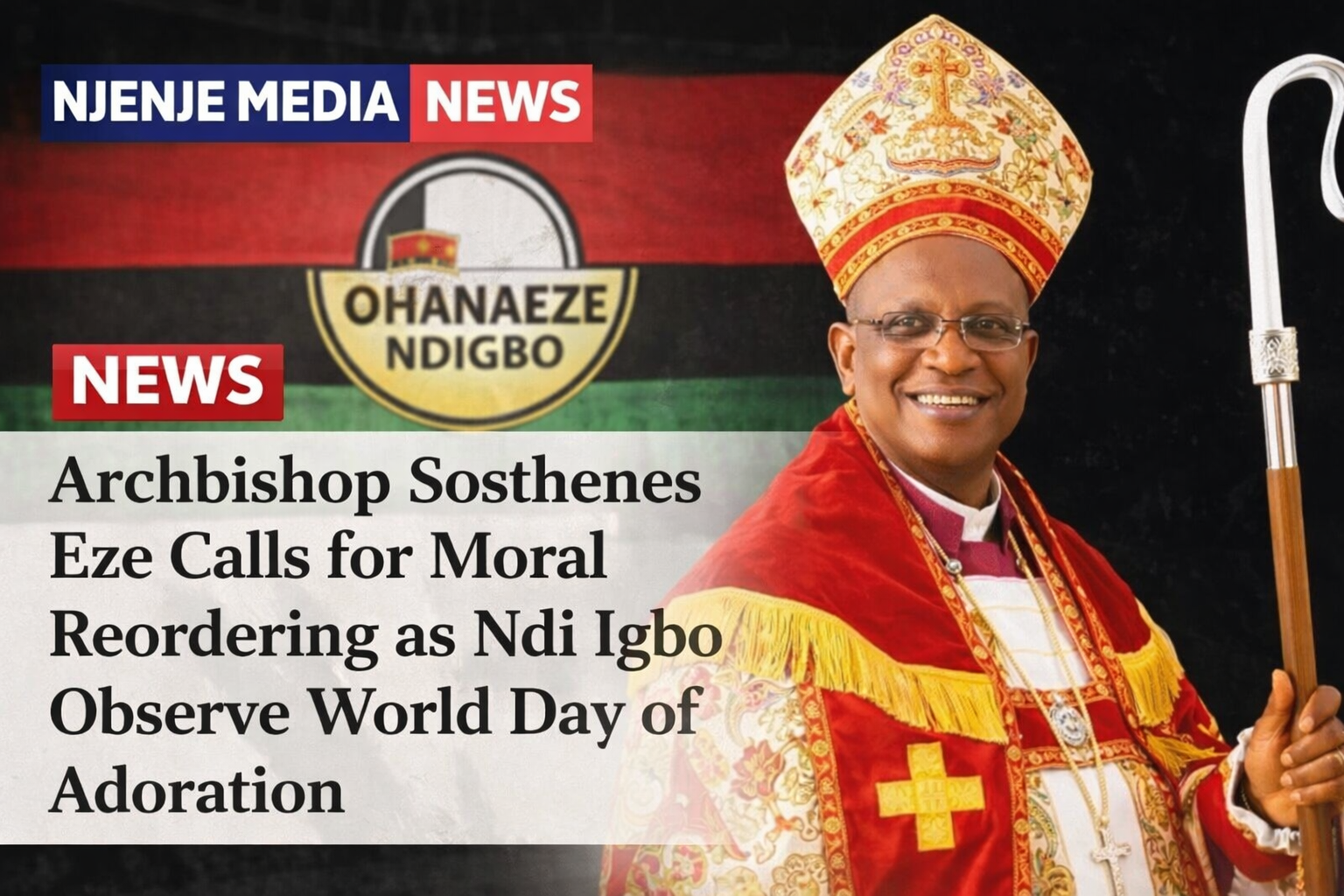
Archbishop Sosthenes Eze Calls for Moral Reordering as Ndi Igbo Observe World Day of Adoration
By Njenje Media
Enugu | London – As uncertainty, fear, and moral drift continue to challenge social cohesion in many parts of Nigeria, leading faith leaders are increasingly emphasising spiritual responsibility as a pathway to societal renewal.
This was the focus of The State of the Igbo Nation series, aired by Njenje MediaTV, where Most Rev. Engr. Sosthenes Ikechukwu Eze, Archbishop of the Ecclesiastical Province of Enugu and Bishop of the Anglican Diocese of Enugu North, examined the significance of the newly proclaimed Igbo World Day of Adoration and Thanksgiving and its relevance to the moral and civic future of Ndi Igbo.
Archbishop Eze described the proclamation as a collective call to restore meaning, discipline and shared direction in Igbo public life, noting that remembrance without moral responsibility cannot heal a wounded society.
Watch the full video below:
According to the Anglican Archbishop, the trajectory of Igbo progress within Nigeria and across the globe is fundamentally linked to spiritual alignment. He highlighted Enugu’s historical role as the industrial and political nerve centre of the old Eastern Region, tracing its economic foundations to the 1909 coal discovery and its early missionary influence.
He stated that sustained intercessory efforts, including prayers of repentance and thanksgiving undertaken quietly over the years by faith leaders and community stakeholders, laid the groundwork for the present initiative.
“No nation rises sustainably without a spiritual foundation,” Archbishop Eze said, stressing that gratitude to God is a strategic act of national restoration rather than a ceremonial gesture.
Thanksgiving Beyond the Shadows of War
Reflecting on the Nigerian civil war and its aftermath, the Archbishop noted that Ndi Igbo have endured profound loss, economic dispossession and repeated targeting during national crises, yet continue to demonstrate resilience and enterprise.
He recalled the post-war denial of financial assets and persistent attacks on Igbo properties across the country, describing the survival and recovery of the Igbo nation as evidence of divine preservation deserving of collective thanksgiving.
Drawing from biblical precedents, he maintained that praise and gratitude have historically served as instruments of national healing and redirection.
A Call to Reorder Values
Archbishop Eze emphasised that the Igbo World Day of Adoration is not merely an act of remembrance but a call to moral recalibration. While acknowledging the industry, adaptability and ingenuity for which Ndi Igbo are known, he identified excessive pride and lack of humility as social weaknesses requiring correction.
He warned that brilliance untempered by humility undermines social acceptance and coexistence, particularly in host communities outside Igboland, and urged Ndi Igbo to engage other cultures with respect and restraint.
Responsible Memory and Collective Purpose
In addressing historical memory, the Archbishop advocated for responsible remembrance that draws lessons from the unity, sacrifice and innovation that emerged during the civil war, rather than sustained emotional fixation on pain.
He noted that wartime ingenuity—evident in indigenous manufacturing and technological improvisation—remains a valuable resource that could be reclaimed for contemporary development.
Gratitude as a Unifying Force
Archbishop Eze described gratitude as a catalyst for unity and moral clarity, arguing that thanksgiving shifts collective consciousness from grievance to appreciation, strengthening social bonds and restoring trust.
“When gratitude increases, division diminishes,” he said, adding that spiritual renewal ultimately reshapes public behaviour and leadership culture.
Engineering Discipline in Pastoral Leadership
Linking his background as a trained engineer to his ecclesiastical leadership, the Archbishop explained that planning, structure and foresight are essential components of effective spiritual and societal governance.
He observed that weak planning has undermined many institutions and stated that faith-driven initiatives must be supported by disciplined execution to achieve lasting impact.
Role of Political Leadership
The Archbishop underscored the critical role of political leaders in translating spiritual renewal into tangible societal outcomes, noting that governance, policy and resource allocation determine the direction of communal progress.
He called for stronger collaboration among political authorities, traditional institutions, business leaders and faith communities to secure a stable and prosperous future for Ndi Igbo and Nigeria at large.
Global Observance
The Igbo World Day of Adoration and Thanksgiving will be observed globally on 31 January, from 9:00 a.m. to 12 noon, and will thereafter be held annually on the last Saturday of January.
Archbishop Eze identified gratitude to God, unity in diversity, humility in engagement and commitment to the common good as the central pillars of the initiative.
The programme forms part of The State of the Igbo Nation series produced by Njenje Media.