
Over 10,000 Nigerians Killed in 2 Years — Leaders Unite Across Divides to Say Enough
On a recent visit to a Middle Belt state, I witnessed firsthand the despondency of communities losing faith in dialogue and peace. It was clear that silence was no longer an option.
I contacted leaders across political, ethnic, and religious divides to begin a dialogue. Together — former ministers, party leaders, civil society advocates, and academics — we resolved to issue this statement, calling for a recalibration of our security system and a renewal of our national ethos.
Though we, the signatories, differ on many fronts, we are united in our Nigerianess, shared humanity, and faith in a common destiny. Drafting this statement was as educative as it was enlightening — it tested our opinions, forced us to confront the complexity of the crisis, and compelled us to rise above prejudice.
This statement is our collective expression of hope: we can still stem the bloodletting and rekindle our national possibilities.
For perspective: while Ukraine lost about 12,000 civilians in two years of war, and Syria averages 3,000–5,000 deaths annually, Nigeria has lost over 10,000 lives to violent killings, while officially “at peace.” From Benue and Plateau to Zamfara, Sokoto, Katsina, Niger, the Northeast, and the Southeast, Nigerians bleed as though at war.
This Joint Statement by Concerned Nigerian Leaders is a call to conscience. Please read it, share it, and let history record that we did not stay silent.
Osita Chidoka
24 August 2025A Joint Statement by Concerned Nigerian Leaders on the Deepening National
Security Crisis
We, leaders and citizens drawn from every part of this country — diverse in ethnicity, faith and
political tradition — come together compelled by a painful truth: our nation is bleeding. We stand
united by one conviction that rises above all differences:
silence is complicity, and inaction is
betrayal.
In just two years, Nigeria has recorded at least 10,217 violent killings, according to Amnesty
International. These numbers stagger the conscience. For perspective: over roughly the same
period, Ukraine’s war has claimed 10,000–12,000 civilian lives, Gaza’s devastating siege has taken
over 35,000, and Syria, still reeling from civil war, now averages 3,000–5,000 deaths annually.
Parts of Nigeria are enduring wartime levels of slaughter, yet we are officially at peace.
The devastation at home is chilling. Benue State alone has witnessed 6,896 killed, over 450,000
displaced, entire local councils hollowed out by fear. Plateau has lost 2,630 lives, its boreholes
poisoned, granaries torched, farmers forced to watch harvests rot for fear of ambush on the road to
market. Zamfara has seen at least 638 villages sacked, and residents are now paying criminal
levies by phone under threat of mass killings.
Similar horrors persist in Sokoto, Kebbi, Katsina and Niger, where bandits have turned entire
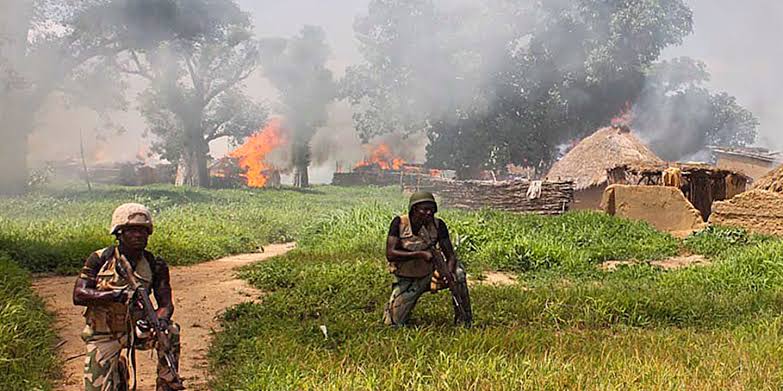
districts into fiefdoms. Meanwhile, Boko Haram is resurging in the Northeast, regaining the
ability to launch deadly assaults, kill servicemen and even attempt overruns of local governments,
as seen in recent attacks on Gwoza, Damboa, Biu and Bama, forcing farmers off their fields and
reviving fears of the dark days when the entire country trembled under their shadow. The
Southeast, too, is gripped by relentless killings by unknown gunmen, making peace increasingly
elusive.
Why Does This Nightmare Continue?
At its heart, our crisis reveals a brutal fact: the Nigerian state has surrendered its monopoly on
the legitimate use of force. New armed groups flourish — Lakurawa in Sokoto and Kebbi,
Mamuda in Kwara, alongside local militias that exploit old grievances. What began as herder and
Page 1 of 6
farmer disputes over land and water has morphed into sectarian wars, stoked by military-grade
weapons and deep distrust.
Perhaps the most alarming thing is the national silence. The ritual of press condemnations after
each massacre, and the swift return to other mundane issues, is now a national pastime. This is not
resilience. It is the slow implosion of a nation and a rot of its conscience.
Lessons from Around the World
Other countries, torn by even deeper divisions, found the courage to change course.
Colombia was once ravaged by guerrillas, cartels and paramilitaries. Its state lost vast territories to
terror, a predicament all too familiar to parts of Nigeria today. Change came only when leaders
across rival camps acknowledged they had lost control, funded local peace deals, spurred economic
renewal, and reformed their security forces. This convergence of national will gradually pulled
Colombia back from the brink of collapse.
Rwanda, haunted by genocide, did not look away from its ethnic wounds. It established grassroots
courts to pursue accountability, reintegrated communities, and reformed security institutions to
ensure the state’s reach extended to the remotest villages. Nigeria, too, bears deep scars of identity
— ethnic, religious, and regional tensions, that demand similar bold, structural confrontations.
Northern Ireland, after decades of bombings and reprisal killings, only found peace when its elites
decided violence could no longer shape the future. They forged power-sharing deals under local and
international guarantees, proving even the deepest hatreds can be unwound.
These were not perfect journeys. They were fraught with setbacks and painful compromises. Yet
they stand as enduring proof that crises on this scale are not immutable. They yield to political
courage, elite consensus, and a willingness to confront hard truths. Nigeria’s path demands no
less.
A Dangerous Narrative that Must End
We must resist the temptation to blame this violence on one group alone. As recent revelations in
Katsina, Anambra, Benue and Plateau have shown that, while some of the attackers are
Page 2 of 6
foreigners with local collaborators, many of the attackers are Nigerians, sons of the soil, from
various communities, who have abandoned kinship for criminality.
This is a Nigerian problem with Nigerian faces. The challenge is not ethnic, but systemic:
poverty, arms proliferation, impunity, injustice, and the erosion of local governance. We must lift
the veil of stereotypes and deal with the truth: criminals come from every group; justice must be
blind to identity.
The way forward
We refuse to be silent accomplices. We call on the Presidency, National Assembly, Governors,
traditional rulers, religious leaders, security chiefs, civil society, and every Nigerian of
conscience: let us forge a new path.
We propose urgently creating a Presidential Task Force on National Security, with extraordinary
powers and a clear mandate to coordinate and execute emergency measures to halt the violence.
This Taskforce should work directly with the National Security Adviser (NSA) and all relevant
security, intelligence, and humanitarian agencies.
Its mandate should include:
1. Operationalising community-based early warning systems and rapid response
frameworks, ensuring that intelligence from local actors, traditional leaders, and civil
society triggers immediate coordinated action, not bureaucratic delay.
2. Implementing a disarmament and reintegration programme for conflict zones,
particularly in the North East, North Central and North West, combining humanitarian
assistance with strategic security deployment to enable the safe return of displaced
populations.
3. Driving accountability through quarterly public security reports, disclosing arrests,
prosecutions, and progress made — thereby rebuilding public trust and strengthening
civilian oversight.
The Presidential Taskforce must be time-bound, results-driven, and composed of experienced
security professionals, non-partisan Nigerians of unquestionable integrity, and war-time decision-
makers who are bold enough to use their mandate responsibly and transparently.
Page 3 of 6
The body should report directly to the President but operate independently of political pressures.
These are unusual times, they require unusual but constitutional measures.
A Final Word
Nigeria stands on a knife-edge. Whether we tip into chaos or climb toward peace depends on
what we do next. If Rwanda, Colombia, and Northern Ireland can emerge from darker abysses, so
can we, if our leaders, across the villa, government houses and Assembly, our palaces, pulpits, and
barracks, take the more challenging road of reconciliation, justice, and reform.
The right of every Nigerian child — in Bokkos, Gwoza, Maru or Yelwata — to grow up without
fear is not negotiable.
History will not judge the bandits. It will judge us who had the power to protect, and either
rose to this moment or shrank from it.
May God grant us the courage to act, and may He heal our land.
Osita Chidoka South East
Mohammed Abdullahi
North Central
Sergius Ogun South South
Kadaria Ahmed North West
Nuruddeen Muhammad North West
Abdullahi Maibasira North Central
Dr Ali Bappayo adamu North EastPage 4 of 6
Basharu Altine Isah North West
Ismaeel Ahmed North West
Hon Dr Midala Usman Balami North East
Frank Nweke Jnr
South East
Tolu Aderemi South West
Paul Ogbole North Central
Opeyemi Adamolekun
South West
Jamila Bio Ibrahim North Central
Tonye Patrick Cole South South
Ugo Egbujo
South East
Sam Amadi
South East
Abba Bukar Abba Masta
North East
Contact:
Osita Chidoka
+234 803 445 5037