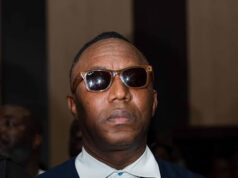


Former assistant director of the Unity Party of Nigeria, UPN, in the Second Republic, was in the trenches during the battle against military rule that birthed the current democratic dispensation as national publicity secretary of the National Democratic Coalition, NADECO. In this interview, he spoke on the state of the nation, raging war against insecurity, the way forward for the country and why he wrote a new book: The Gun Hegemony.
What inspired you to write The Gun Hegemony?
After I was arrested by the military and whisked off to Abuja where I spent 33 months at DSS headquartered and later taken to Kano Central Prison where I spent 16 months, I made up my mind during my detention that I would write two books. The first was my Prison Memoirs that was presented at MUSON Centre in year 2000.
Second, I was convinced that except for the power of the gun i could not have been so captured and hounded by people of mean reputation who do not mean well for our society and had arrested our growth and development.
Here is me, who is defending the rights of the ordinary man being captured like a felon. I thought that the gun was the major factor in the matter. I, therefore, decided that I was going to deal with the matter of the gun-those who wield it, those who are in custody of it, that is the Army.
So, The Gun Hegemony was inspired by a seeming race to return to the state where might is right, brutish and nasty as well as a deep concern about normalisation of violence as a tool of power globally and particularly in fragile democracies like Nigeria.
After several decades of civic engagement, I have observed how the dominance of armed force, whether by the state, non-state actor or criminal networks has displaced dialogue, justice, and moral authority.
This book attempts to interrogate that dangerous trajectory and provoke a serious national and global conversation.
I am also concerned with the seeming lasting negative effect prolonged military dictatorship has had and still holds on Nigeria’s political space. The fact that the military organogram where power flows from the commander-in-chief downward has become normalised with virtual total contempt and disrespect for the popular will of the public has become too worrisome to ignore.
What central argument does the book make?
The central argument is that when societies surrender moral authority and democratic accountability to the logic of the gun, they inevitably undermine their own stability. The Gun Hegemony argues that unchecked militarisation of politics, security, and even civic life erodes institutions, deepens fear, and weakens citizenship. Sustainable peace cannot be built on coercion alone; it must rest on justice, inclusion and accountable governance.
The kinetic power of the gun has led to virtual state of lawlessness today in Nigeria, suggesting that our national security architecture must be reconfigured for effect.
Is the book focused only on Nigeria?
While Nigeria provides a compelling and urgent case study, the book is deliberately global in outlook. Nigeria has the largest population of black people globally and has to get it right so that she can respond to her manifest destiny in providing leadership to the black race.
I draw parallels from Africa, the Middle East, and parts of the Western world where gun dominance-whether through military might, proxy wars or internal repression-has reshaped societies. Nigeria’s experience, however, vividly illustrates how the failure to control violence can threaten national and regional cohesion.
The book presents the historical discovery of the gun in human existence and implications. Without the gun, perhaps, there would have been no geographical space called Nigeria. The book looks at who discovered the gun, its transformation and significant influence.
On argument that strong military force is necessary in today’s security climate
Security is essential, but force without accountability becomes oppression. The book does not argue against legitimate security forces; rather, it warns against the elevation of force above law, ethics, and civilian oversight. History teaches us that when the gun becomes the final arbiter, even those who wield it eventually lose control.
Who should read The Gun Hegemony?
This book is for policymakers, security professionals, scholars, civil society actors, faith leaders, and young people who care about the future of democracy and peace. It is also for ordinary citizens who want to understand why violence persists and how societies can reclaim authority from fear and force.
What do you hope the launch on January 15 will achieve beyond book sales?
The launch is meant to be more than a literary event. I hope it becomes a platform for sober reflection and policy dialogue among leaders, diplomats, intellectuals, and citizens about how we can reverse the culture of violence and rebuild trust Institutions. If the book stimulates honest debate and interest for others to write and influences thought, then it has served its purpose.
What message would you like Nigerians to take away from this book?
My message is simple but urgent: No nation can shoot its way to peace. True security comes from justice, equity, and respect for human dignity. If we allow the gun dominate our politics and our conscience, we mortgage the future of coming generations.
On the origins of prevailing insecurity in Nigeria
When in 2001/2002 when Boko Haram started; and when Governor Sani Yerima of Zamfara State established Sharia Law, we campaigned against it vigorously. Section 10 of the Nigerian Constitution stipulates that Nigeria is a secular state, establishing Sharia Law means you are adopting another constitution. It was an illegality that ought to be nipped in the bud but President Okuseguj Obasanjo said then that it was a political Sharia that would soo. fizzle out.
However, 11 other states joined Zamfara to make it 12 across the country. Because they encouraged this illegality for their political shenanigans it festered. They pumped money into the hands of these characters who are jobless, and abandoned them after using them for elections.
When the DSS arrested their leaders twice, Obasanjo was prevailed or blackmailed into accepting the false and ridiculous notion that the DSS officers who worked for the arrest were Christians, and so they were released. When they became so large and started breaking into Police, Air force, and military barracks some said it was due to lack of actionable intelligence. The DSS leadership said it was not true, they had intelligence and arrested the terrorists but those arrested were freed.
Again, you to look at the Nigerian security situation from two dimensions-local and international. The entire Sahelian region-Mali, Mauritania, Nigeria, Burkina Faso, Chad, etc don’t have much green pastures any longer. They are looking for green pastures; because they have their kith and kin leading Nigeria severally, they were drawn into Nigeria. And all they have been doing is to see how they could establish themselves-attack natives on their land, eliminate them and take over possession. Destroy their farms, when they complain, shoot them. Otherwise, what does a herdsman need an Ak-47 rifle for? And it has been encouraged for political purposes. This is part of the impact of the gun.
However, for the first time, there is somebody in power, President Bola Tinubu, who was not sponsored by the military. He is doing his utmost but the prolonged years of military dictatorship in Nigeria and what it established cannot be wished away over night.
With the current dynamics of what the government is doing, having understood that you need a combination of both kinetic and non+kinetic power to establish some credible security structure in the country, I hope it will start bearing fruit when Nigerians start having quality and cheap food on their table, and employment is available for majority of the people.
In the true of sense of it, none of all the predecessors of Tinubu can claim to have better economic and financial experts as he does. He is in a position to transform the national economy to lift a significant number of people out of poverty because our people have really suffered and are still undergoing terrific level of poverty, agony that are miserable, undesirable and intolerable. I wish that efforts being made will yield dividends
On the killings rising instead of abating in spite of the efforts
At my installation as the grand patron of the Christian Association of Nigeria, CAN, at Offa, Kwara State, I said and reiterate that the current phase of killings and violence are not accidental. They are deliberately schemed and sponsored by the opponents of the government.
A former governor of a state in the North-West told us what they did with bandits in 2014/2015, disclosed how they got in touch with the bandits and so on. After using them you want them to return to the dry place they came from. They refused and went into the forests.
But the former governor was in the same party with President Tinubu then…
You can only tell how violence will start and how it will end. They achieved their purpose then.
Remember that candidate Buhari in 2011 said if he did not win blood would flow and blood flowed. Several thousands of people were killed. What happened, was he brought to book? was he asked to answer any question?
2027 election is approaching. With this kind of violence do you think we’ll have an election?
Well, I hope the government should be in a position to rectify or do whatever it can because the credibility of such election rests on the fact that they make the country governable, peaceful for people to be able to go and cast their votes.
What is your advice to Nigerians as we head towards the election?
My advice is that having been dominated by military dictators for such a prolonged period with their somersaulting economic policies that had ravaged Nigeria, stunted our growth and made us an underdeveloped country the process of undoing what they have done cannot come overnight.
That’s why the pain and agony that people are going through becomes very worrisome but perhaps a necessity. You cannot eat an omelette without breaking an egg. I just hope that all the efforts that have been made of which the government is telling us that the time for reaping the benefits of the agony has come, is right.
I take a shot at one or two things that President Bola Tinubu has succeeded in doing in recent times.
He took a shot at fiscal federalism with these tax reforms.
Those who have benefited from the lopsided disaggregated multiple tax regimes don’t want this new tax reforms and they are fighting tooth and nail to prevent its emergence but it has started.
When we look at the charts of tax contribution to the gross domestic product Nigeria is one of the least in the world. Most Nigerians don’t pay tax. The ones who pay tax are government workers from their lean resources. Many rich people don’t pay tax.
As a lawyer, what is your take on the forgery controversy trailing the tax laws?
My view is that once a law is passed and assented to by the president it becomes law. True, people can raise objection, and the National Assembly is attending to it.
So, let the National Assembly attend to it. if the National Assembly whose responsibility it is to discuss the bill go through and say what we sent to you is not what you are operating then they can decide, they have their powers to take the necessary action. So, let the appropriate body of the state handle it when they fail to act it is then we can handle those who are charged with that responsibility in the Constitution.
What is the way forward for the country to get fiscal federalism and then begin to operate a egalitarian society?
The efforts by the National Assembly to amend the Constitution are good enough. I believe that sooner or later Nigerians must sit down to respond to the national question.
Nigerians as a people and as a country must sit down to respond to one twin question.
First, yes we were forced into co-habitation by the colonialists with their power, yes this is an heterogeneous society of over 350 ethnic nationalities with different languages, religion, culture, tradition, artefacts, folklores, etc. We secured our independence on a federal constitution, we didn’t seek for a change of that federal constitution. The military and politicians in uniform on January 15, 1966 overthrew the democratically elected government of Nigeria, suspended and abrogated that negotiated constitution and substituted for it their military unitarised and centralised governance in Nigeria.
That is the cause of our problem. Until we return to it to the federal constitution we are just chasing shadows.
Have Nigerians ever answered the question whether they want to belong to Nigeria? We have not been asked and that is why up to today everyone first of all wants to be a member of his ethnic nationality.
Nigeria is a country. Perhaps giving the prolonged years of our relationship, may be we say can yes we want to be together. If we say yes, the second question is how you are going to relate to be together in the country. On what terms, what is the modus operandi, the rule of engagement that will bind us?
These are to be packaged together in a federal constitution.
Credit: Vanguard News.