

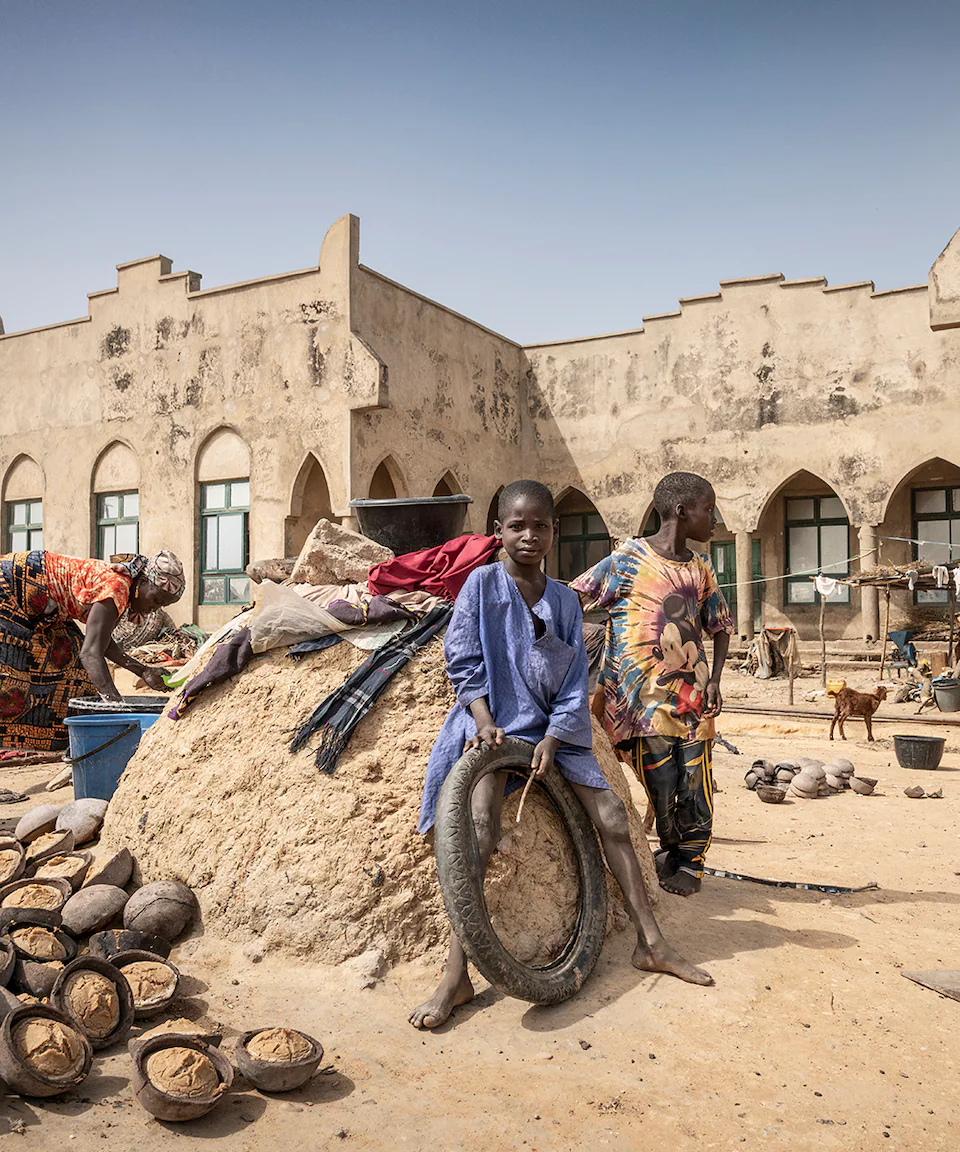
In Anka, Zamfara State, northwest Nigeria, thousands of displaced families are sheltered in the grounds of an abandoned Emir’s palace. Among them is 20-year-old Bashirya Murtala, whose two-month-old daughter, Rahila, lies critically malnourished. “She has been weak since I gave birth,” Bashirya shared. Her husband’s meager earnings as a bricklayer, often as low as 500 naira (25p) a day, barely cover food for the family.
Despite being Africa’s most populous country and one of its largest oil producers, Nigeria faces a dire hunger emergency. The UN estimates that 32 million Nigerians—14% of the population—are in “crisis” levels of food insecurity. Malnutrition is especially deadly for children under six months, with millions at risk of severe wasting.
The Roots of the Crisis
Nigeria’s rapid economic growth in past decades was once a model for the region. However, poor governance, corruption, and global economic disruptions have led to a severe downturn. President Bola Tinubu’s recent economic reforms, including removing a long-standing fuel subsidy and devaluing the naira, have exacerbated the crisis. These measures, although supported by the World Bank as “necessary,” have triggered soaring inflation and plunged millions deeper into poverty.
The cost of living crisis is devastating. Fuel prices quadrupled, transport costs skyrocketed, and basic foodstuffs became unaffordable. Over 83 million Nigerians now live in extreme poverty, surviving on less than $2 per day. “Economic management in Nigeria has been woeful,” said Professor David Luke of the London School of Economics, highlighting the absence of a social safety net to protect vulnerable citizens.
Banditry and Lawlessness
In the rural northwest, hunger is compounded by escalating violence. Armed groups, known locally as bandits, terrorize farming communities, extorting ransoms, destroying crops, and displacing entire populations. Haruna Ibrahim, a 28-year-old vigilante, joined a local resistance group after bandits kidnapped his sister. “We faced a lot of challenges,” he said, describing attacks by heavily armed gangs who frequently raid villages on motorcycles.
Farmers who resist extortion face dire consequences. One community refused to pay a “tax” demanded by bandits and saw their crops incinerated in retaliation. Kidnapping is rampant, with victims subjected to forced labor and sexual violence. In some cases, communities pool funds to pay ransoms, but many abductees never return.
Starving Mothers and Children
Malnutrition is at catastrophic levels, particularly among women and children. The World Food Programme (WFP) estimates that 5.4 million children and 800,000 pregnant or breastfeeding women are at risk of wasting, the most life-threatening form of malnutrition. Dr. Raphael Kananga of Doctors Without Borders described the situation as “terrifying,” warning of “children dying in record numbers” without urgent action.
In Sokoto State, 10-month-old Saadatu Abubakar was admitted to a WFP-supported clinic in critical condition, suffering from anaemia, sepsis, and acute malnutrition. Her mother, Aisha, had spent a small fortune on transport to reach the clinic. “Even when she gets better, we will only end up back here,” Aisha lamented, unable to afford the food necessary to sustain her child’s recovery.
Delays in medical access, fueled by insecurity, further worsen the crisis. Doctors often cannot travel to conflict zones to provide follow-up care for malnourished children. “We can’t tell how many children are dying from malnutrition; it is very difficult,” said a local doctor.
Survival at Any Cost
Desperation has driven some women into sex work to survive. Sabara, a 27-year-old from Katsina city, earns just 1,000 naira (47p) a day selling her body but says it’s the only way to feed herself. “I want to start a new life,” she said.
Even in cities, hunger is pervasive. In Abuja, grain warehouses were looted earlier this year, leading to violent clashes. Protests dubbed the “Ten Days of Rage” erupted in August despite the government doubling the minimum wage to 70,000 naira (£35.60).
A Generation at Risk
The effects of hunger are generational. Malnourished mothers give birth to stunted babies, who suffer irreversible physical and cognitive damage. Breastfeeding mothers often lack sufficient calories to produce milk. Dr. Ifuk-Ibot John Ala, a WFP nutritionist, warned, “Households that would’ve been able to cope last year are now having trouble.”
The insecurity and lack of infrastructure in the northwest make delivering humanitarian aid nearly impossible. The WFP’s Chi Lael described the region’s plight as “a wildfire of insecurity ripping through the northwest.”
Without immediate action, Nigeria risks losing an entire generation to hunger, malnutrition, and violence. As one displaced mother in Anka grimly put it, “We moved here because our home was no longer safe.”
Sourced from The Telegraph