
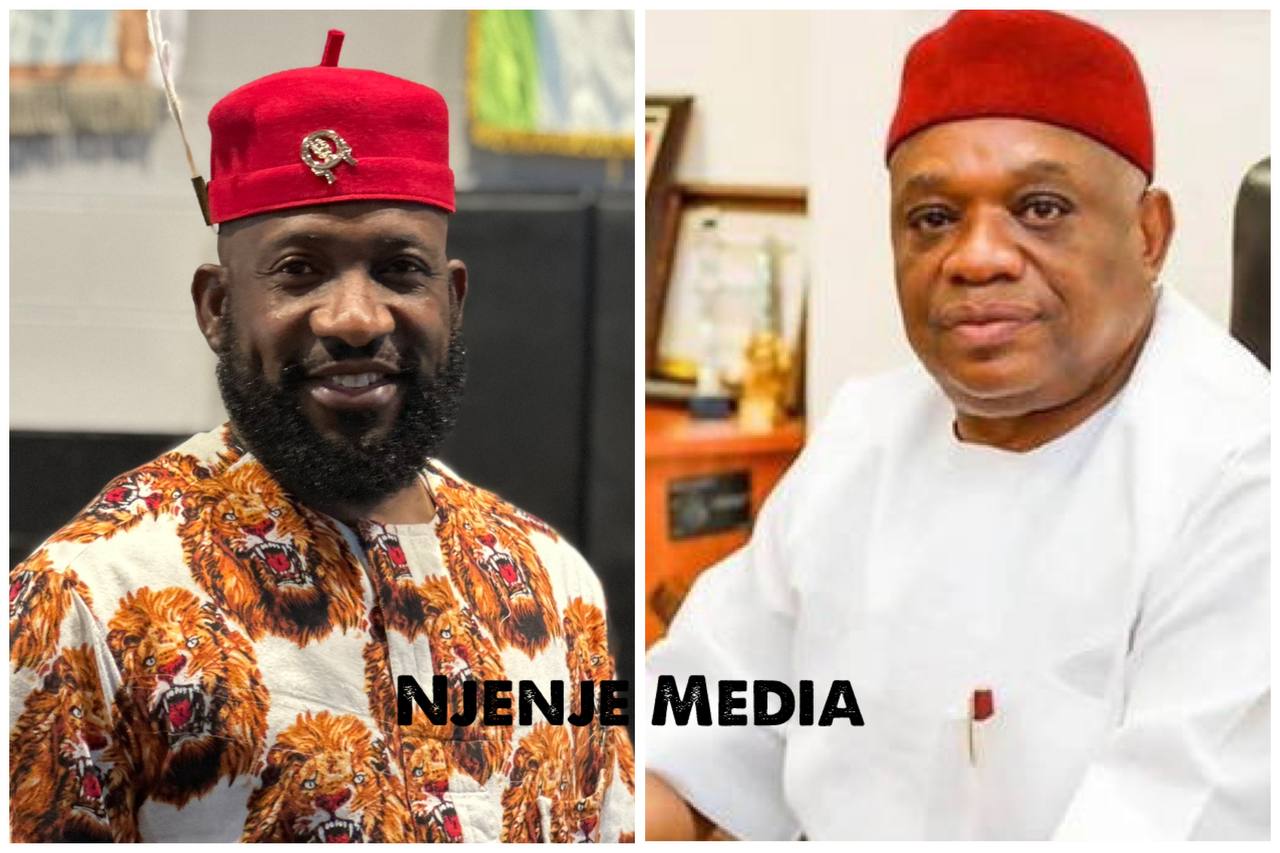
OP-ED: Senator Orji Uzor Kalu’s Inflated Claim of 4.9 Million Votes in 2007: A Dangerous Distortion on Channels TV – Maazi Tochukwu Ezeoke
In a Tuesday interview on Channels Television’s Politics Today program, hosted by Seun Okinbaloye, Senator Orji Uzor Kalu claimed he secured 4.9 million votes in the 2007 Nigerian presidential election as the Progressive Peoples Alliance (PPA) candidate.
This assertion is unequivocally false. According to the Independent National Electoral Commission (INEC), Kalu polled 608,803 votes—a figure far removed from the 4.9 million he alleged. Such a blatant misrepresentation, made on a prominent platform amid speculation about the 2027 elections, demands correction, as it undermines public trust in Nigeria’s democratic process.
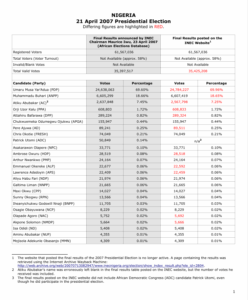
The 2007 presidential election saw Umaru Musa Yar’Adua of the Peoples Democratic Party (PDP) win with 24,638,063 votes. Muhammadu Buhari of the All Nigeria Peoples Party (ANPP) secured 6,605,299 votes, while Atiku Abubakar of the Action Congress (AC) garnered 2,637,848 votes. Kalu’s 608,803 votes, though notable for a lesser-known party like the PPA, placed him well behind the leading candidates. His claim of 4.9 million votes is not just inaccurate but an attempt to distort a verifiable piece of Nigeria’s electoral history, using it to bolster his self-proclaimed status as “the most important politician from [the Southeast] zone. ”Why would a sitting senator make such a false claim on a widely watched platform? The answer may lie in political posturing.
By inflating his electoral performance, Kalu aimed to exaggerate his influence and dismiss challengers like Peter Obi, whom he explicitly rejected as “not my leader,” challenging, “Any day you want to discuss Peter Obi with me, give us two hours. Keep him there and keep me here, and we’ll sort it out.” He further boasted, “I have won two states before. I ran for president in 2007 and got 4.9 million votes. We had ministers and ambassadors under President Yar’Adua. You cannot be telling me that anybody can run for president and suddenly become my leader.” However, this tactic falters when confronted with INEC’s documented results. Misrepresenting electoral outcomes, especially in a high-profile interview, erodes credibility and fuels public skepticism in a nation where trust in institutions is already fragile.
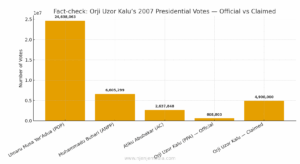
The 2007 election was marred by allegations of irregularities, yet INEC’s official figures remain the authoritative record. Kalu’s claim, aired on Politics Today, disrespects the Nigerian electorate and undermines efforts to strengthen democratic accountability. As a former governor and current senator, he should uphold truth, not distort it—particularly while advising former President Goodluck Jonathan to “quit politics” and “remain the statesman [he is],” citing constitutional limits on terms, or crediting himself for thwarting Olusegun Obasanjo’s alleged third-term bid. This incident underscores a broader challenge: misinformation thrives when leaders prioritize narrative over facts. Nigeria’s democracy, grappling with voter apathy and electoral mistrust, cannot afford such distortions—especially as Kalu defends President Bola Tinubu’s reelection prospects for 2027, declaring, “None of these people parading themselves can defeat President Tinubu,” while lamenting Igbo marginalization since the Civil War and calling for national unity.
With the 2027 elections looming, political figures must model honesty to rebuild confidence in the system. Senator Kalu must retract his Politics Today claim and acknowledge the correct figure of 608,803 votes. This would not diminish his political journey but demonstrate integrity. Nigerians value truth over exaggeration, and a correction would show respect for the electorate. Citizens, too, must hold leaders accountable by demanding factual accuracy and rejecting revisionist claims.
The truth of the 2007 election is clear: Kalu did not secure 4.9 million votes; he earned 608,803. This discrepancy, amplified by his Channels TV interview, is not trivial—it strikes at the heart of democratic credibility. By correcting the record, Kalu can contribute to a political culture rooted in transparency. Nigeria’s future depends on leaders and citizens upholding truth, ensuring our democracy stands on a foundation of trust and accountability.