
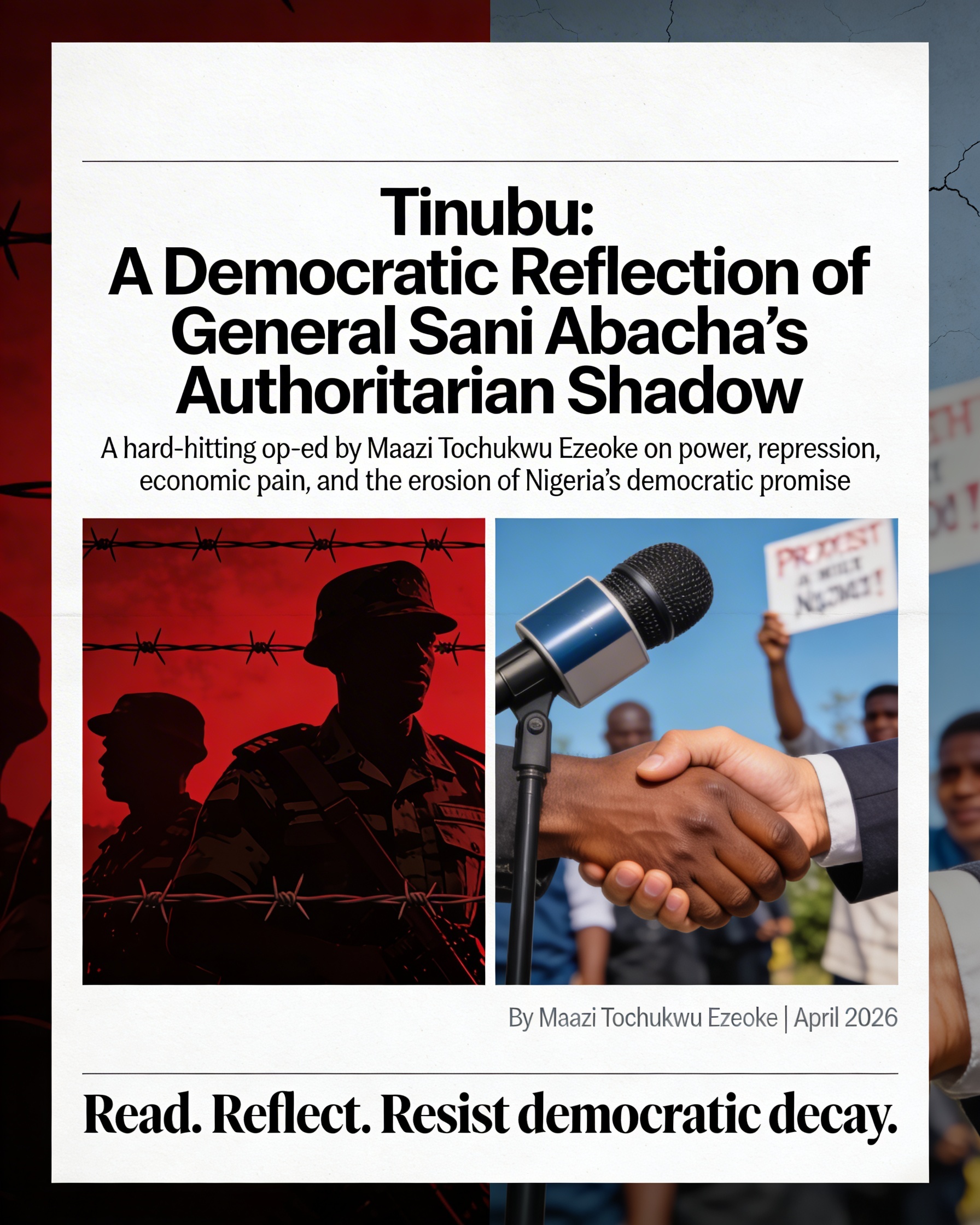
Tinubu: A Democratic Reflection of General Sani Abacha’s Authoritarian Shadow
By Maazi Tochukwu Ezeoke, (April 2026 Edition)
In the annals of Nigerian history, few names summon dread like that of General Sani Abacha, the iron-fisted military ruler whose 1993–1998 dictatorship became a byword for plunder, paranoia, and pulverised dissent. To many Nigerians, Abacha’s name evokes a nightmare of repression: journalists jailed, activists executed, billions spirited abroad. Yet, more than two decades after his death, his shadow lengthens once more, cast not by khaki but by agbada.
Bola Ahmed Tinubu’s presidency, now nearing its midpoint since his May 29, 2023, inauguration, increasingly mirrors Abacha’s authoritarian choreography, albeit draped in democratic robes. Through obsessive power consolidation, weaponised institutions, and widening inequality cloaked as reform, Tinubu has transformed Nigeria’s Fourth Republic into a stage where democratic rituals persist, but the democratic spirit weakens.
The politics of engineered dominance
Abacha’s infamy rested partly on his self-succession project, five political parties so submissive they were derided as the “five fingers of a leprous hand.” Each dutifully “nominated” him as Nigeria’s next civilian president before death spared the country from that fraud in 1998.
Three decades later, Tinubu’s ruling All Progressives Congress (APC) is orchestrating a more sophisticated version of the same script. Opposition fragmentation has become the central political technology of 2026. The Labour Party, riven by leadership crises, staggers under court battles widely perceived as encouraged by pro-APC interests. The PDP stumbles through defections, while smaller platforms like the ADC dissolve under the gravitational pull of power. What Abacha achieved through decrees and detention, Tinubu’s political machine accomplishes with patronage, judicial engineering, and economic carrot-and-stick tactics, designed to render 2027 not an election, but a coronation.
Economic “reform” as moral theatre
Abacha’s dictatorship was stained by kleptocracy; billions in oil revenues disappeared into offshore havens while Nigerians queued for basic goods. Tinubu’s era, for all its democratic packaging, echoes the same moral dissonance.
The removal of fuel subsidies and the unification of the naira in mid-2023 were hailed as bold market reforms. Yet, they unleashed historic inflation, consumer prices soared above 35% by early 2026, food inflation breached 45%, and poverty deepened, pushing an estimated 14 million Nigerians below the poverty line within two years (according to NBS projections). The naira’s freefall, crossing ₦1,800 to the dollar in February 2026, has left wages worthless while government elites float new budgets for luxury jets and banquet halls.
Tinubu’s economic narrative, sold abroad through investor forums in Davos and Riyadh, rings hollow at home. The metaphorical “sacrifice” demanded of Nigerians recalls Abacha’s austerity promises, where the people endured suffering while the ruling class fattened on state largesse.
Human rights under democratic disguise
Abacha turned fear into policy. Journalists like Kunle Ajibade and activists like Ken Saro-Wiwa paid for dissent with freedom and life. Today, Nigeria again flirts with that darkness, though with subtler instruments.
Under Tinubu, protest has been recoded as sabotage. The EndSARS memory lesson, how a peaceful movement was crushed in 2020, lingers. In 2024, security agencies violently dispersed anti-hunger demonstrations in several states. In 2025, some bloggers faced government “falsehood” charges. Even whistle-blowers in the civil service speak of retaliatory transfers.
The judiciary, once perceived as the last democratic firewall, appears increasingly pliant. Controversial tribunal rulings, such as the judicial validation of the 2023 presidential election despite disputed INEC uploads, have deepened cynicism. Abacha ruled by edict, Tinubu governs through procedural capture: different tools, same outcome: the narrowing of civic space.
A tragic historical symmetry
Perhaps the bitterest irony lies in Tinubu’s own political origin. This was the same man who, as part of the NADECO pro-democracy movement in the 1990s, risked his life resisting Abacha’s tyranny. He fled into exile, returning a hero when the dictator died. Yet today, Tinubu personifies the centralisation and intolerance he once fought.
History, it seems, does not merely repeat; it rhymes ominously. Abacha died abruptly in 1998, leaving behind billions in recovered loot and a traumatized polity. Tinubu, though operating within a multiparty democracy, now toys with the very autocratic instincts Abacha perfected: absolutism in all but name.
The choice before 2027
As Nigeria approaches another election cycle, the moral question looms large: will Nigerians reassert genuine pluralism, or sleepwalk into a managed democracy? The temptation of unchecked power has swallowed republics before. Tinubu still has time, barely, to reverse course, to restore institutional independence and economic justice.
Democracy thrives on accountability, not adulation. If this government continues its drift toward concentrated rule, history will not remember Tinubu as the defender of June 12 ideals, but as their gravedigger.
Nigeria deserves better than recycled strongmen in civilian clothing. And this time, we no longer have the excuse of ignorance; we have the mirror of our past, staring right back at us.
Maazi Tochukwu Ezeoke writes from Awka, Anambra State