
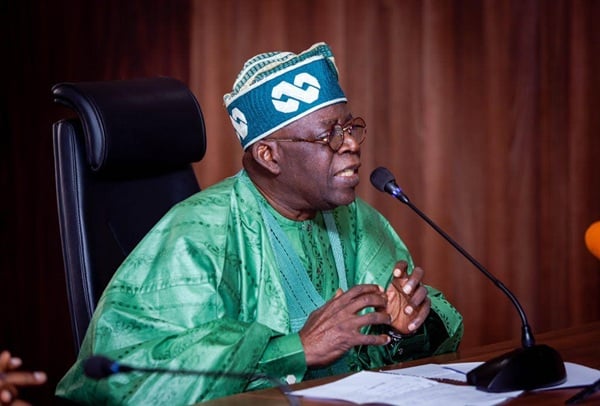
President Bola Tinubu has formally requested approval from the House of Representatives to access external capital amounting to $2.347 billion, aimed at financing portions of the 2025 budget deficit and refinancing maturing Eurobonds.
According to the letter read by Speaker Abbas Tajudeen during Tuesday’s plenary and obtained by Njenje Media News, the borrowing plan includes a new external loan of ₦1.843 trillion (at the budget exchange rate of $1/N1,500) and the refinancing of $1.118 billion Eurobonds due to mature in November 2025.
The proposal outlines that the funds could be raised through one or a combination of the following options in the International Capital Market (ICM): issuance of Eurobonds, loan syndications, bridge finance facilities, or direct borrowing from international financial institutions.
Tinubu also requested parliamentary approval to issue a stand-alone debut Sovereign Sukuk of up to $500 million in the ICM, with or without credit enhancement. He noted that this move aligns with Nigeria’s ongoing efforts to diversify funding sources and deepen the government securities market.
Speaking on the significance of the request, the President emphasised that the 2025 Appropriation Act includes ₦9.27 trillion in new borrowings to partially finance the budget deficit. Out of this amount, approximately $1.229 billion will be sourced externally under the proposed framework.
As reported by Njenje Media News, Tinubu’s letter highlighted the government’s intent to refinance maturing Eurobonds to avoid default, describing it as a “standard practice in global debt capital markets.” The plan aims to ensure Nigeria maintains its credibility and stability in the international financial arena.
The Debt Management Office (DMO) and the Federal Ministry of Finance will collaborate with transaction advisers to secure the most favourable terms. Pricing and tenors for the new Eurobonds, Tinubu noted, will depend on prevailing market conditions and investor preferences at the time of issuance.
Between 2017 and May 2025, the DMO successfully raised ₦1.39 trillion through domestic Sukuk issuances to fund critical road infrastructure projects. Tinubu now seeks to extend this success internationally by tapping into external Islamic finance sources, including potential guarantees from the Islamic Corporation for the Insurance of Investment and Export Credit (ICIEC).
Njenje Media News also learned that the proposed borrowing package reflects the administration’s broader strategy to strengthen fiscal sustainability while bridging Nigeria’s infrastructure funding gap through diversified capital market instruments.