

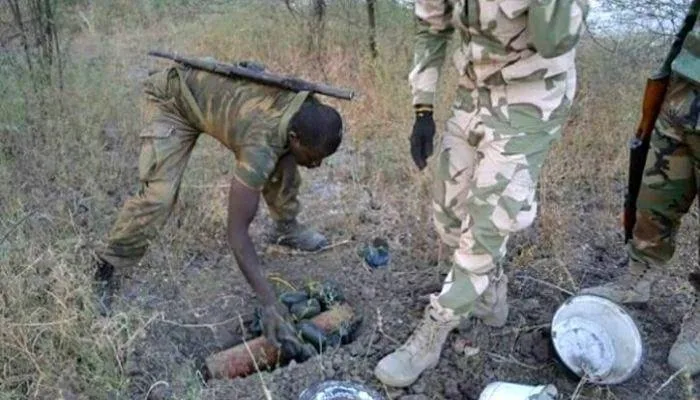
At least eight Nigerian soldiers have reportedly died after a landmine struck an army patrol vehicle in Borno State, with military and local security sources attributing the attack to the Islamic State West Africa Province (ISWAP).
The incident occurred on Saturday in Kinuba village, approximately 25 kilometres from Gamboru, close to Nigeria’s border with Cameroon, according to defence sources who spoke to Agence France-Presse (AFP) on Sunday.
The attack happened on the same day the Chief of Army Staff, Lieutenant General Waidi Shaibu, visited Maiduguri, the Borno State capital, following an earlier attack on a military base that reportedly claimed the lives of 15 soldiers and five members of an anti-jihadist militia.
Sources said the troops were inspecting militia members involved in clearing thick vegetation along a highway outside Gamboru when their vehicle struck the explosive device.
The blast reportedly killed all eight soldiers inside the vehicle.
“All eight soldiers in the vehicle were killed in the explosion,” a military officer in the region told AFP.
Ibrahim Liman, a member of an anti-jihadist militia supporting the military, confirmed the reported casualty figure, explaining that the explosive had been concealed on the dusty road and detonated remotely.
“The explosive was planted on the dusty road and remotely detonated by a detonating cord,” Liman said.
He added that a militia member overseeing the vegetation-clearing exercise suffered shrapnel injuries during the explosion.
The sources blamed ISWAP for the attack, although the attribution was based on accounts provided to AFP.
Landmine Attacks Deepen Security Concerns
The incident underscores the persistent danger posed by improvised explosive devices along roads used by military personnel and civilians across Nigeria’s North-East.
ISWAP and its rival faction, Boko Haram, have increasingly deployed landmines and other explosives to attack military patrols and civilian vehicles.
Thick vegetation bordering highways also provides cover for ambushes targeting soldiers and motorists, making security operations in the region more challenging.
Nigeria’s jihadist insurgency began in 2009 and has claimed tens of thousands of lives, while forcing an estimated two million people to flee their homes across the North-East.
Although the violence declined from its peak roughly a decade ago, attacks have reportedly increased in recent years, according to the AFP report.
The conflict has also spread into neighbouring Niger, Chad and Cameroon, leading to regional security cooperation and the deployment of a multinational military coalition to combat the armed groups.