
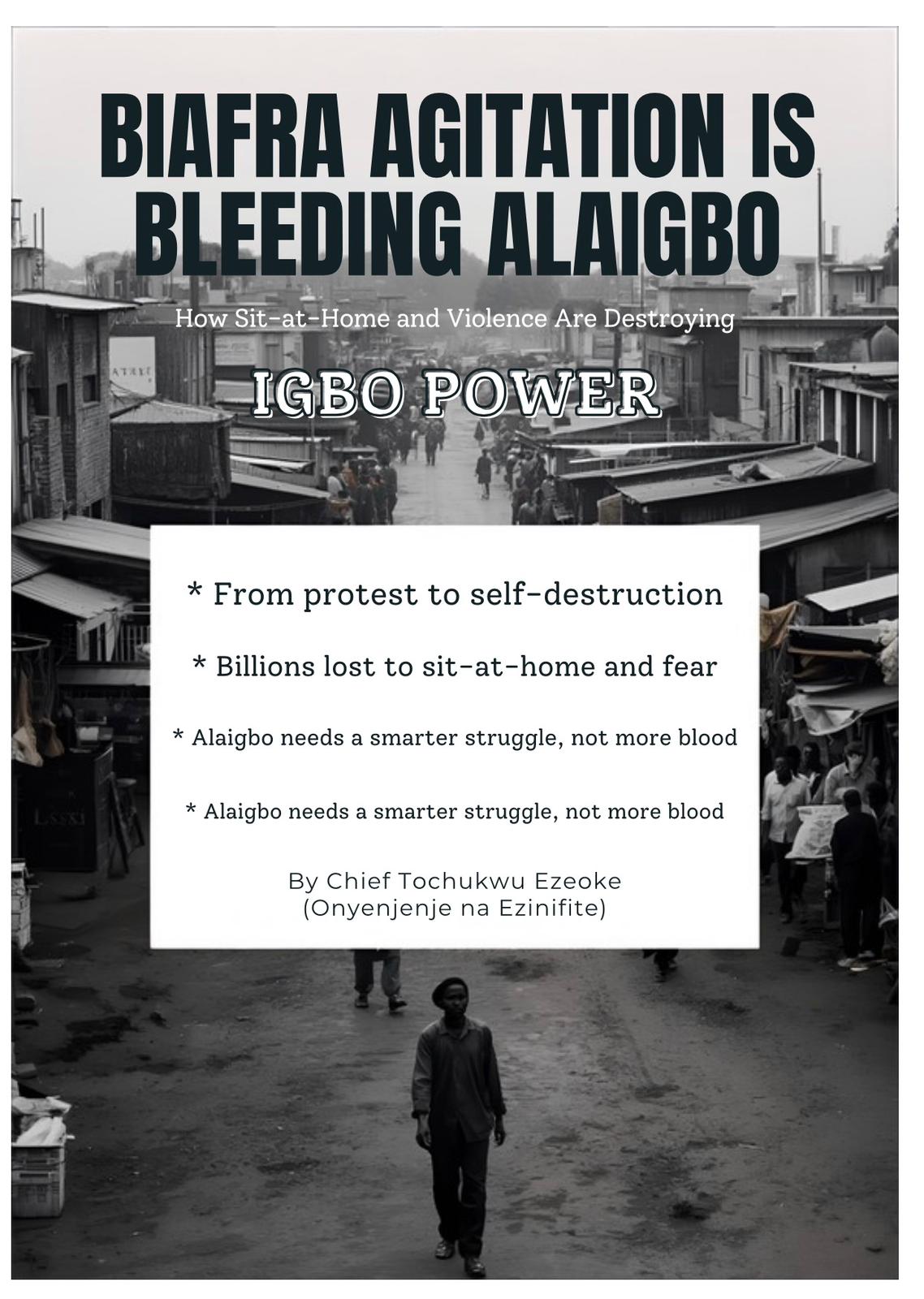
Ndi be anyi, the Biafra agitation as it is presently prosecuted is no longer a cry for justice; it is now a machine that is grinding the South-East into fear, poverty and political irrelevance. If we truly love Alaigbo, we must have the courage to discard any strategy that is destroying our people faster than our enemies ever could.
## From protest to self-destruction
The grievances that birthed renewed Biafra agitation are real: historic killings, structural marginalisation, and a political system that has kept Ndigbo away from the highest levers of power since 1970. Federal structures, appointments and resource allocation have for decades under-represented the Igbo in the executive, legislature and judiciary, while the presidency has rotated between North and South-West. These wounds are deep, and any honest conversation must acknowledge them.
But a just cause can be destroyed by a reckless method. The current wave of Biafra separatist agitation shows a clear pattern: sit-at-home orders, blockades, attacks on security agents and civilians, and the militarised response they invite have combined to create a spiral of lawlessness in the South-East. Instead of healing marginalisation, we now have a region where ordinary people wake up every Monday asking one question: “Will I return alive if I go out today?”
## The economic bleeding of Alaigbo
Across the South-East today, the economic picture is sobering. Businesses shut their doors on sit-at-home days, with traders counting losses that run into billions of naira annually across major cities like Onitsha, Aba and Nnewi. Market leaders and small business owners alike link continual unrest directly to shop closures, job losses and a steady slowdown in regional economic growth. Many investors now deliberately avoid the South-East because of chronic insecurity and unpredictability, preferring to move their warehouses, factories and logistics hubs to Lagos, Ogun or even Ghana.
In plain terms, sit-at-home, road blockades and threats have disrupted commercial activity across the region, killing the very trading spirit that has defined Ndigbo for generations. Violent activities under the banner of agitation have worsened business growth and reduced both output and investment in the region. For a people whose greatest natural resource is not oil but **enterprise**, this is economic suicide.
The Igbo man who leaves his shop locked every Monday does not hurt Abuja; he hurts his children’s school fees, his apprentice’s dreams, and the future of his town. No serious ethnic group seeking power destroys its own markets and repels investors from its homeland.
## A region turned against itself
Violence has repositioned the South-East from a zone of resilience to a theatre of fear. In just a few years, the region has recorded hundreds of attacks and hundreds of deaths linked to so-called enforcement of sit-at-home orders and “unknown gunmen” activities. States like Imo and Anambra have been worst hit, with communities counting a trail of burnt vehicles, razed police stations and murdered travellers.
These are not abstract numbers; they are fathers burnt in their vehicles for “violating” sit-at-home, mothers caught in crossfire, and youths gunned down in clashes between armed groups and security agents. The militarisation of the region, with heavy-handed responses by security agencies, has led to extrajudicial killings and deepened mistrust between citizens and the state.
What began as agitation “for the people” has, in many communities, turned into extortion, kidnapping, and criminal gangs hiding under Biafra rhetoric. Villages once known for solidarity now live in silence; people whisper in buses, pastors shorten evening services, and parents fear to send their children to school when rumours of a “ghost Monday” spread. A movement that makes your own people afraid of your own streets has lost its moral compass.
## Political shrinking of Ndigbo
Politically, the consequences are even more dangerous because they are subtle but long-lasting. Ndigbo already suffer strategic under-representation in federal decision-making and national leadership positions. Instead of building smarter political coalitions to break this pattern, the current agitation is hardening the stereotype of the Igbo as “unreliable, secessionist and ungovernable” in the eyes of other regions.
Every time voters in the South-East are forced indoors on election days or intimidated away from polling units by unknown gunmen, we shrink our bargaining power at the centre. Low turnout means fewer votes to negotiate with, fewer legislators emerging from our region, and weaker leverage in the distribution of federal projects and appointments. When a region repeatedly positions itself in permanent opposition, or appears hostile to national processes, it invites further isolation in the very institutions where decisions are made.
No serious ethnic group seeking the presidency or key security posts encourages narratives that it wants to break away by force. The Yoruba did not achieve June 12 vindication and a South-West presidency by burning Lagos every Monday. The North did not secure decades of dominance by shutting down Kano markets weekly in protest; they organised, negotiated and inserted themselves into every critical node of the Nigerian state.
If Ndigbo truly desire an Igbo president, equitable appointments, and fairer resource distribution, the path cannot be one that convinces others that we are leaving the union by bullets and fear. It must be a path that demonstrates capacity for order, governance, and alliance-building.
## Why we must change course
The truth is painful but liberating: the current model of Biafra agitation is hurting Ndigbo more than it is hurting those we accuse of marginalising us. It is collapsing our economy through chronic insecurity, sit-at-home paralysis and investor flight. It is turning our homeland into a war theatre where our young men die between separatist guns and military bullets. It is weakening our political leverage by depressing turnout, reinforcing negative stereotypes, and isolating us from national coalitions.
Discarding this strategy does not mean forgetting our dead or accepting injustice. It means refusing to fight tomorrow’s battles with yesterday’s weapons. Peace and stability improve economic indicators and attract investment, while conflict and instability drive away capital and slow development. A South-East known for security, booming industry and high voter participation will command more respect, not less, in the Nigerian federation.
The emotional energy behind Biafra is not useless; it is powerful. But that energy must be redirected into building regional economic powerhouses through industrial parks, technology hubs and export-driven markets; forming disciplined political movements that negotiate across regions and contest power strategically at all levels; and investing in education, data, legal advocacy and media to tell the Igbo story compellingly without violence.
Ndigbo have turned war ruins into thriving cities before; we can turn this season of fear into a new era of disciplined, intelligent struggle for dignity. The agitation we must embrace now is not one that shuts our shops and spills our blood, but one that opens more factories, fills more classrooms, and puts more of our brightest minds into the rooms where Nigeria’s future is decided.
History will not remember us for how loudly we shouted Biafra on social media; it will remember whether Alaigbo in our time became safer, richer and more politically influential. On that score, the current agitation is failing. For the sake of our children, we must have the courage to say: this road does not lead to freedom. Let us turn, together, and choose a wiser path.
Chief Tochukwu Ezeoke