

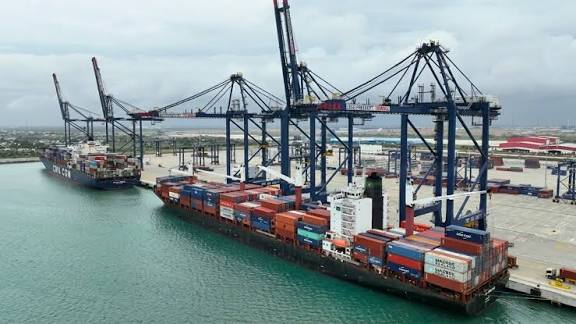
Nigeria’s port industry recorded significant expansion in 2025 as cargo movement, container handling, and export activities rose sharply across the country’s major seaports, according to the Nigerian Ports Authority’s Operational Performance Report for the year.
The report shows that total cargo throughput climbed by 24.8 percent, increasing from about 103.6 million metric tonnes in 2024 to more than 129.3 million metric tonnes in 2025. The surge represents one of the most notable yearly increases in Nigeria’s maritime sector.
Managing Director of the Nigerian Ports Authority, Dr Abubakar Dantsoho, described the performance as an important step in strengthening Nigeria’s position in both regional and international trade. Imports still accounted for the largest share of cargo traffic at 59.2 percent, while exports contributed 39 percent, reflecting government efforts to expand non oil trade. Transshipment cargo made up 1.8 percent of the total.
Activity involving containerised goods also rose significantly. The volume of container traffic increased by 25.7 percent, exceeding 2.1 million Twenty foot Equivalent Units. Export containers grew by 3.1 percent, imports rose by 32.8 percent, while transshipment containers recorded a dramatic increase of 205.8 percent. Industry observers say this trend points to Nigeria’s growing role as a logistics gateway for West and Central Africa.
Lekki Port handled the largest share of cargo, accounting for 40.6 percent of total throughput nationwide. Onne Port followed with 19.1 percent, while Apapa Port processed 16.7 percent. Lekki Port also accommodated the biggest vessels, with ships averaging 55,712 Gross Registered Tonnage, slightly ahead of Onne Port’s 53,022. Tin Can Island Port recorded the highest number of vessel arrivals at 22.7 percent, although the largest ships increasingly favour Lekki and Onne.
The total number of ship visits rose by nearly 12 percent during the year, reaching 4,477 vessels. Liquid bulk cargo remained the most dominant commodity, representing 54.7 percent of total cargo handled, while containerised goods accounted for 24 percent. Analysts say the rising capacity and size of vessels visiting Nigerian ports indicate gradual alignment with global shipping operations.
The report also highlighted the increasing importance of transshipment cargo, particularly containerised goods moving through Nigeria to other African destinations. This development has strengthened Nigeria’s standing as a regional maritime hub while increasing revenue potential for the ports authority.
According to maritime analysts, the growth in export and transshipment volumes suggests that reforms aimed at reducing reliance on crude oil exports and improving port efficiency are beginning to produce results.
Dantsoho expressed optimism that ongoing reforms and infrastructure upgrades would sustain the momentum. Planned improvements include deeper berths, rehabilitation of quays, expansion of cargo handling facilities, and the introduction of digital systems to shorten vessel turnaround time and improve safety and operational efficiency.
The report indicates that Lekki Port and Nigeria’s broader port network are becoming increasingly important to the country’s economic diversification plans and its ambition to strengthen participation in global trade and supply chains.