
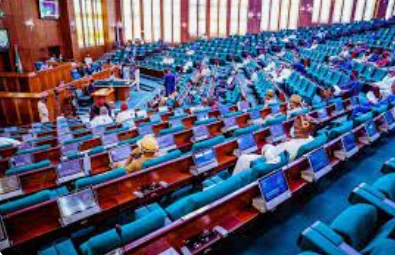
A rowdy session broke out on the floor of the House of Representatives on Wednesday as lawmakers disagreed over which committee should question the Governor of the Central Bank of Nigeria, Olayemi Cardoso, on the alleged non-remittance of more than ₦16tn in government revenues.
The uproar followed the adoption of a motion titled “Non-remittance of over ₦5tn operating surplus and ₦11tn government revenue by the Central Bank of Nigeria,” sponsored by Osun lawmaker and Chairman of the Public Accounts Committee, Bamidele Salam.
Salam urged the House to invite the CBN governor to provide explanations and present “actionable measures” for the immediate payment of all outstanding debts owed to the Federal Government.
Kano lawmaker Ghali Tijani subsequently moved for an amendment proposing the creation of an ad-hoc committee to handle the assignment, a position supported by Mark Esset of Akwa Ibom.
The suggestion sparked opposition, particularly from Ahmed Jaha (APC, Borno), who insisted that the matter remained the responsibility of the Public Accounts Committee, which had already been investigating various financial irregularities for two years.
According to Jaha, “The sacrosanctity of this institution cannot at whatever level of influence be compromised because of the powerful nature of a head of an agency. The Committee on Public Accounts, we are all aware, is being chaired by a qualified, competent, and committed member,Honourable Bamidele Salam. He has the capacity, likewise, his members of the committee. I know them. I am not a member of Public Accounts Committee.”
He added, “Mr Speaker, we are trying to strengthen him, not to undermine his Committee. We have to tell each other the truth. We should not undermine the sanctity of our Committees. Since the committee has written several times to the agency and they have not been honouring it, this time around, we need a resolution of the House for them to appear before the committee.”
Jaha further urged the House to issue a firm directive.
“Let there be a resolution on the floor of this House, forcing and compelling the agency to appear before the committee on public accounts whether they like it or not,” he said.
Contributing to the debate, Sada Soli (Katsina) also backed PAC, arguing that it remained constitutionally empowered to handle such matters.
“This is the only Committee that is mentioned in the Constitution. Mr Speaker, this committee is being chaired by an opposition. So, I believe they will do the right thing, and I believe they have done the right thing,” he said.
He warned that the allegations contained in the motion were troubling for the nation’s economic managers.
“The revelations in this motion are so damning. They must pay attention to this kind of report,” he added.
Soli insisted that the House should issue a direct summons rather than an invitation.
“I don’t think this House should invite the Governor of the CBN. This House should invoke Order 19, Rule 1, and Rule 2 of our order book. We should summon him,” he noted.
He faulted Cardoso’s past refusal to honour invitations, saying, “Why should the House invite him? After all, the Committee that has been charged with the responsibility have invited this public officer, an appointee of the President. He disregarded the invitation of a committee and the institution that appointed that committee.
“Mr Speaker, that behaviour is unacceptable to this parliament. It’s unacceptable to Nigeria. It’s a wake-up call to those who manage this economy so that at least, we will try to stop this rascality,” he noted.
A proposal by Lagos lawmaker, Babajimi Benson for a multi-committee ad-hoc panel comprising the Committees on Finance, Banking Regulation and Public Accounts was also rejected.
The chamber became agitated before Tijani eventually withdrew his amendment. The House then adopted Jaha’s revised proposal that “the House do resolve to summon the CBN governor and relevant agencies involved to appear before the Public Accounts Committee unfailingly.”
During the debate, Salam briefed lawmakers on PAC’s findings from its investigation into the Auditor-General’s Report for the 2022 financial year and the administration of the Remita Revenue Collection System by the CBN between March 1, 2015, and April 30, 2016.
He reported that the Committee discovered a CBN liability of ₦5.2tn in unpaid operating surpluses for 2016–2022 that “has remained unremitted to date.”
Salam also disclosed discrepancies in charges collected through the Remita platform.
According to him, “Refunds of Collected Charges by the Central Bank of Nigeria showed amount collected by the Central Bank of Nigeria as ₦954m; amount refunded by the CBN, ₦0.00. Difference/variation is ₦954m.”
He added that with interest computed at a monetary policy rate of 27.25%, amounting to ₦2,329,027,728.92, “Total amount due for refund is ₦3,283,330,305.05.”
The lawmaker further revealed a migration discrepancy of ₦2,686,325,119,825.10 “being outstanding and payable to the Federal Government’s Assets Recovery Account.”
He concluded that cumulatively, the CBN was indebted to the Federal Government to the tune of over ₦11tn, arising from multiple infractions and unexplained discrepancies.
Salam lamented the CBN governor’s consistent refusal to appear before PAC, stating, “Despite several formal communications and invitations, the CBN has failed, refused, or neglected to honour the invitations or effect the required remittances as directed by the committee.”
The Public Accounts Committee is the only committee established by the Nigerian Constitution, mandated to examine reports of the Auditor-General and ensure accountability in the management of public funds.
Over the years, the Committee has spearheaded inquiries into mismanagement of revenue, irregular expenditure, and breaches of financial regulations across ministries, departments and agencies.
In the 10th Assembly, the Committee has intensified scrutiny of key government institutions, particularly revenue-generating bodies, due to mounting concerns about leakages and unremitted funds.
Its ongoing investigations stem from persistent gaps identified in audited government accounts, prompting a closer examination of the CBN’s handling of revenue collections and operating surpluses.
The latest revelations form part of a broader effort by PAC to strengthen financial discipline, recover public funds, and ensure that agencies—especially strategic ones like the CBN—adhere strictly to statutory remittance obligations.