
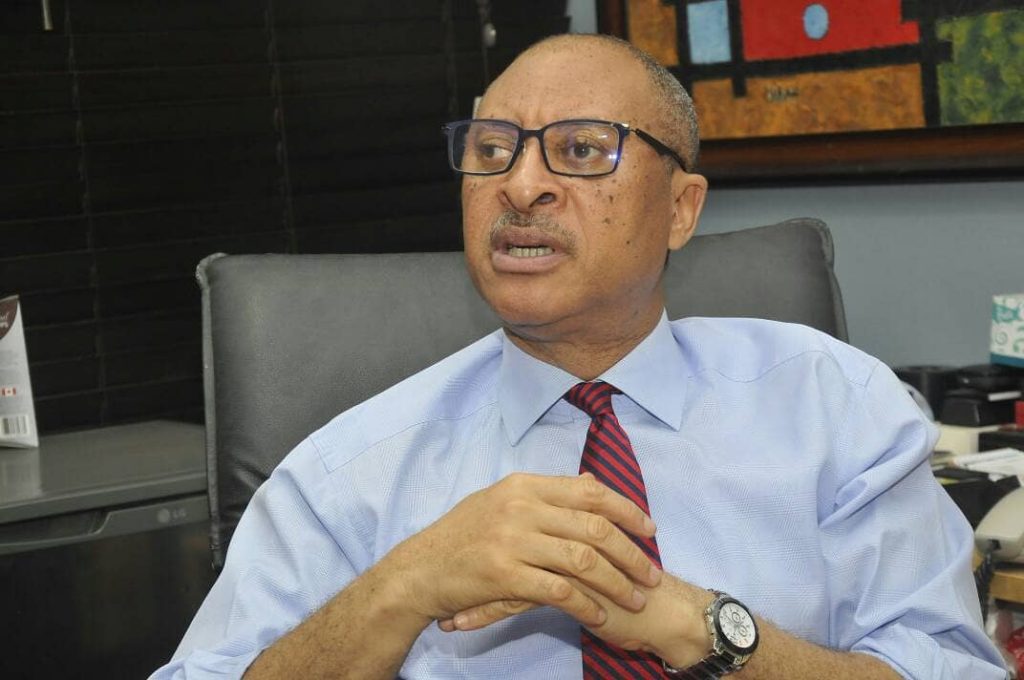
Thank you, sir, for the exciting conversations with the quintessential Prof Pat Utomi on the need for a shadow government in Nigeria.
In a nutshell, it is argued that a shadow government aims to project a sense of elite collective responsibility as a battle cry for good governance and a positive worldview of Nigeria. As a corollary, elsewhere, Barr. Olisa Agbakoba argued that the democratic governance system isn’t working for all in Nigeria: as a result, he called for an overhaul of the system, and, replace it with a model that works for all.
I agree that what Nigeria desperately needs “now” is political stability, economic prosperity and social justice as concrete evidence of good governance: a shadow government is unlikely and unsuitable to deliver on the objective of its creation due to its recursiveness.
On the contrary, Nigeria is now in a desperate need of restructuring for true federalism in order to resolve the spate of ongoing structural problems created by overbearing ethnic balance of power (eBoP) that has stifled good governance, political stability, economic prosperity and social justice.
The observed eBoP is largely responsible for the glaring absence of a strong elite consensus required to create a positive world view of Nigeria. This has implications for the legitimacy of government to deliver good governance that works for all. As a result, governmental policies end up being recursive in execution to the chagrin of citizens.
The basis for true federalism is one in which the federating units of Nigeria are founded on the local identity of autochthonous residents. The current federation of Nigeria is based on composite territorial administrative units: it is obtuse and engenders the observed eBoP that rocks the polity.
The colonial enterprise that created Nigeria as a single territorial entity from 1914 was achieved by war, law and praxis of settler colonisation. Hitherto, the territories of diverse ethnic peoples existed based on ethnic homeland statecraft whose initial-conditions consent was not yielded for the creation of Nigeria.
In 1950, the initial-conditions consent of Nigeria indigenous ethnic groups was sought by a wide-ranging constitutional consultation in Enugu, Ibadan and Kaduna: two pertinent questions were posed by the colonial administration at each session and on 9th January at the Ibadan session. In response to question one, a strong elite consensus emerged for federalism as the choice system of government.
Question 2 was about the basis of federalism “such as the many linguistic [i.e. ethnic] groups which exist in Nigeria” and remains unanswered to this day; this is the core national question that is the basis for the strident advocacy to restructure Nigeria based on the local identity of autochthonous (i.e. ethnic) residents.
Obvious progress in regard to the basis of federalism raised in question 2 got on course with the attainment of self-rule cum enactment of a republican constitution on 1st October 1963. The yearnings of indigenous ethnic groups for true federalism led to the establishment of two commissions on Ethnic Minority Rights in Nigeria. This eventually led to the creation of Mid West Region in 1963 as a 4th federating unit in Nigeria to sustain the tempo towards an ultimate restructuring of Nigeria based on the local identity of residents.
The framework of the local identity of autochthonous (i.e. ethnic) residents derives from the minority doctrine that emerged from the 1648 treaty of Westphalia that healed Europe of devastating wars and restored it to political stability, economic prosperity and social justice. This ennobled the relevance of the concept of diversity, equity and inclusiveness (DEI) as an antidote to eBoP, which is supported by the outcome of an empirical study some countries in 1971.
The Big Tent Initiative is a noble one that needs to amplify the voices of advocates, such as the MNR, for true federalism in Nigeria: this will help with the task at hand to complete the foundation for a solid formation of the Nigeria nation-state by discharging question 2 of 1950. The ongoing distraction in dissipating energies on ethnic struggle for supremacy for political power ascendency, survival and relevance, aka overbearing eBoP will thereby dissolve including its undercurrents for pervasive gangster violence across the entire polity with dire implications for nation-building strides. At this point, the impact of a shadow government in Nigeria will shine forth brightly and be the battle cry for a worldview of the elites in Nigeria.
The role of MNR in Nigeria’s political development is akin to that of a builder; it is a needless distraction to duel on maintenance issues of an unbuilt house. In light of this, the Big Tent Initiative, like the MNR, may wish to consider the hedgehog pathway than be foxy about ongoing political developments that are parallel to its seeded raison d’entre for nation building in the scheme of things. So far, MNR commands the leading voice in the comity of advocates for the restructuring of Nigeria; a legislative Bill has been professionally drafted and sent to the president of Nigeria including leaders of the two chambers of NASS, 36 governors of the littoral states and minister of the FCT. In addition, speaking engagements at fora and media outreaches have kept MNR voice alive on the need to restructure Nigeria “now”.
The short-lived 4-regional federalism that ushered in the era of self-rule from 1963-1966 was based on incongruous territorial delineation. It simply set the track for true federalism: its structure was considered obtuse requiring further refinement that would have been in line with the yearnings of ethnic minorities in Nigeria and a response to question 2 of 1950 that was needlessly deferred by omission or by commission.
Regrettably, the 1963-1966 segment of self rule was lost to a military interregnum that ushered in a unitary system that was rejected in question 1 at the 1950 consultative fora for constitutional governance for “a fully centralized system with all legislative and executive power concentrated at the centre” This has been the bane of governance in Nigeria from 1966 to date, despite de-militarisation for which MNR seeks a departure to re-federalisation.
Da Jonathan Sunday Akuns,
(Galadima Daffo)
Movement for National Reformation