
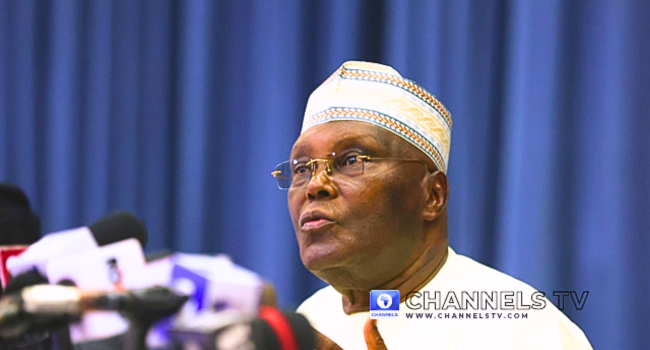
I have been genuinely shocked by the growing chorus of voices—many of them from my own brothers—demanding that Atiku Abubakar should step down and support another candidate. I do not know where this thinking is coming from, but it is deeply troubling and increasingly painful to hear.
One of the most common justifications offered is that “it is the turn of the South.” This argument may sound persuasive on the surface, but once subjected to honest scrutiny, it collapses completely.
Let me state this clearly: there is absolutely NOTHING Southern about the Asiwaju-led APC Federal Government. Beyond the accident of geography, there is nothing in the structure, power distribution, orientation, or outcomes of this government that advances Southern equity—least of all South-East equity. The South-East has gained nothing from this so-called “Southern turn.”
Even more importantly, there is no constitutional or legal backing for the claim that the presidency belongs exclusively to the South at this time. Zoning and rotation remain political conventions, not constitutional mandates. That is why, in an earlier article, I called on the Chairman of the ADC, Senator David Mark, to speak clearly to Nigerians on whether the party intends to pursue constitutional amendment to entrench rotation of power among the six geopolitical zones. Until that is done, every claim of “turn of the South” remains nothing more than a campaign gimmick—one that ironically ends up hurting those who promote it.
I find it particularly disturbing that a friend of mine, who supports a candidate currently about 61 years old, keeps shouting “turn of the South.” I am fully aligned with him on the competence and capacity of his preferred candidate. That is not the issue. The issue is strategy.
That candidate needs a strong Northern partner to win in 2027. And that partner, realistically, is Atiku Abubakar.
If Atiku is blackmailed out of the race on the basis of age or geography, and that candidate still fails to defeat Asiwaju in 2027, the implication is cruel and unavoidable: by the time it allegedly becomes “another turn of the South,” that same candidate would be approaching 78 years of age. What exactly have we achieved then?
I am an advocate of zoning in a complex society like Nigeria. But zoning is far too important to be left to the whims, emotions, and selective memories of politicians and supporters. Any theory of rotation that finds nothing wrong with a Yoruba presidency under Obasanjo, followed by another Yoruba presidency under Asiwaju—while the South-East has never had a shot—is not justice. It is injustice disguised as fairness.
Historically, rotation has never been part of our electoral system. Those who claim that the 1999 election was merely between Obasanjo and Falae conveniently forget that Abdulkadir Balarabe Musa was the presidential candidate of the PRP, which fully participated in that election. History should not be rewritten to suit today’s talking points. The moral contradiction deepens when we recall that the same voices saw nothing wrong with Goodluck Jonathan running in 2015 until he was defeated at the polls. Zoning suddenly became elastic—expanded or contracted depending on who it favoured.
“Atiku, Step Down”: A Misunderstanding of Politics
The demand that Atiku should step down is usually made on a dangerous assumption: that Atiku’s supporters are robots, waiting for him to press a remote control so they can instantly move in the direction he points.
That is not how human beings behave.
And that is not how politics works.
Political support is not a switch. It is the product of decades of trust, relationships, negotiation, sacrifice, and shared struggle. People follow leaders because they believe in them personally—not because they are programmed.
Atiku’s political capital is like a first-class degree certificate. It is impressive. It commands respect. But it belongs exclusively to the person who earned it. It cannot be transferred. No one else can present it as theirs.
Many of Atiku’s supporters are not loyal to party labels. They are loyal to Atiku the man—his experience, inclusiveness, consistency, and national outlook. If he steps aside, they do not automatically migrate to another candidate. Some will reassess. Some will disengage. Some will negotiate their own interests. Some may even sit out entirely.
Politics is not a relay race.
Support is not inheritance.
Let us also remember that Atiku served Nigeria as Vice President for eight years. Once a politician of that stature stops running personally, the default expectation in most democracies is retirement from partisan politics. So when Atiku chooses to remain engaged, it is not an entitlement owed to others; it is a privilege to the political system.
Rather than blackmailing him out of the race, the opposition should recognise the value of having him around and the wisdom in leveraging the goodwill he has built over decades.
Igba Boy and the Question No One Is Asking
As an Igbo man, I am a firm believer in the apprenticeship system—igba boy. It teaches patience, loyalty, humility, and succession based on investment, not entitlement.
So before you ask Atiku to step down for your preferred candidate, ask yourself this:
Why should your candidate be the beneficiary?
In Igbo apprenticeship, nobody inherits the shop by shouting. You earn succession through years of loyalty, service, and sacrifice—often when there is nothing to gain.
Can you boldly say that your candidate supported Atiku consistently, without personal interest, over the years?
If the answer is no, then the assumption that your candidate is the “natural beneficiary” of Atiku stepping aside is entitlement, not strategy.
This is why I worry that we are getting distracted again.
I recently watched Daniel Bwala explaining why a certain individual is “too big” to be Atiku’s running mate. What saddened me was not the argument itself, but the inability of many people to see the plots behind such narratives—deliberate efforts to isolate Atiku, inflate egos prematurely, destroy trust, and scatter the opposition.
History is clear: any opposition that begins by tearing down its strongest pillars in the name of purity ends up gifting victory to the ruling party.
Conclusion
To defeat APC, Atiku deserves support and partnership—not blackmail.
Until rotation is constitutionally entrenched, no one can be morally or legally blackmailed out of the race. Atiku is not an obstacle; he is a strategic asset. His political capital is real, personal, and non-transferable.
If we are serious about rescuing Nigeria, we must abandon emotional ultimatums and embrace political reality.
Anything else is self-deception.
Obunike Ohaegbu
National Coordinator, South East Patriots (SEP)
Writes from his village in Anambra State