
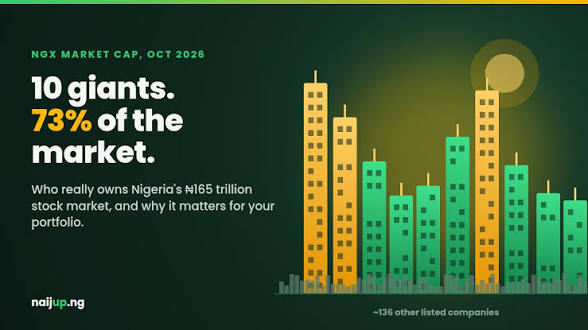
Just 10 companies account for approximately 73 per cent of Nigeria’s ₦165 trillion equity market, highlighting the concentration of market value among a handful of major stocks listed on the Nigerian Exchange (NGX).
An analysis of the NGX Market Capitalisation Report for October 27, 2026, and its Daily Summary price list for October 30, 2026, shows that a relatively small number of large companies largely determine the direction of the market, while about 135 other listed companies account for the remaining value.
NGX Market Capitalisation: ₦225.4 Trillion
The analysis showed that the total market capitalisation of securities listed on the NGX stood at ₦225.38 trillion as of October 27, 2026. However, equities accounted for only about 73 per cent of the figure, with government securities and other financial instruments making up the remainder.
The breakdown is as follows:
– Equities: ₦164.91 trillion (73.17%).
– Federal Government debt: ₦57.22 trillion (25.39%).
– Corporate bonds and debentures: ₦1.31 trillion (0.58%).
– State and local government bonds: ₦571 billion (0.25%).
– Non-Interest Board securities, including Sukuk and Islamic instruments: ₦1.25 trillion (0.56%).
– Commercial papers: ₦65 billion (0.03%).
– Exchange Traded Funds (ETFs): ₦44 billion (0.02%).
This means investors should distinguish between the NGX’s total market capitalisation of approximately ₦225 trillion and its equity market value of about ₦165 trillion when interpreting market performance.
Top 10 Companies Control 73% of Equity Market
Using closing prices from the October 30, 2026, Daily Summary, the 10 most valuable companies on the exchange were:
1. Dangote Cement: ₦23.96 trillion (14.5%).
2. Airtel Africa: ₦23.68 trillion (14.3%).
3. MTN Nigeria: ₦17.85 trillion (10.8%).
4. BUA Foods: ₦13.69 trillion (8.3%).
5. BUA Cement: ₦9.94 trillion (6.0%).
6. Seplat Energy: ₦9.60 trillion (5.8%).
7. Aradel Holdings: ₦6.26 trillion (3.8%).
8. HBM Nigeria: ₦5.64 trillion (3.4%).
9. First HoldCo: ₦5.42 trillion (3.3%).
10. Zenith Bank: ₦4.89 trillion (3.0%).
Collectively, the 10 companies represent approximately 73.2 per cent of the entire equity market.
By comparison, all companies listed on the NGX Growth Board had a combined market capitalisation of ₦330.7 billion, representing just 0.15 per cent of the exchange’s total market value. This is less than one-seventieth of Dangote Cement’s valuation.
Premium Board Accounts for 31% of Entire Exchange
The NGX Premium Board, which represents the exchange’s top listing segment, had eight companies as of October 30, 2026. They were UBA, Zenith Bank, Access Holdings, First HoldCo, MTN Nigeria, Dangote Cement, HBM Nigeria and Seplat Energy.
Their combined market value stood at ₦70.53 trillion, representing 31.3 per cent of the entire exchange, including bonds, and approximately 42.8 per cent of the equity market.
The eight companies also accounted for 613 million of the approximately 998 million shares traded on October 30, representing about 61 per cent of total trading volume. A significant portion of the activity came from a single transaction involving First HoldCo.
Implications for Investors
The figures highlight how the performance of a few major companies can significantly influence the NGX All-Share Index, even when a substantial number of other stocks record losses.
For instance, a 5 per cent increase in Dangote Cement, MTN Nigeria and Airtel Africa could push the overall index higher despite declines across several other listed companies. Investors therefore need to examine the number of advancing and declining stocks rather than relying exclusively on the All-Share Index.
The concentration also raises questions about diversification, particularly for investors holding market-capitalisation-weighted funds and ETFs. Such investments may have substantial exposure to the same handful of large companies, making it important to examine their underlying holdings.
Meanwhile, mid-cap and small-cap companies collectively account for a smaller portion of the market, with approximately 136 companies sharing the remaining 27 per cent of equity value. Although these stocks may present investment opportunities, limited analyst coverage and other risks make independent research particularly important.
The concentration is also evident across sectors such as telecommunications and cement, where only a handful of major companies dominate the listed market, limiting investors’ choices within those industries.