
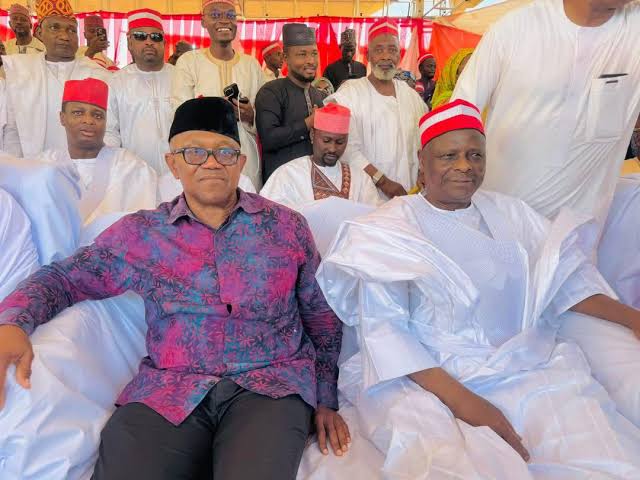
The National Democratic Congress (NDC) presidential ticket which combines the two most organically popular candidates in the South and North appears to be the only truly nationalist ticket for healing. The Peter Obi / Rabi’u Musa Kwankwaso ticket goes beyond a political union between the South East and North West, it incorporates a true journey of reconciliation, fairness, democratic trust, and development for the entire country.
It was the Kano-born politician and NDC chieftain, Buba Galadima, who first asserted, in a recent podcast, that the Obi-Kwankwaso ticket is the only one that symbolises national healing. This declaration is apposite in a season the country desperately needs curative intervention and a fresh start.
It is a ticket that reunites the country after over 56 years of the Nigerian Civil War. Before this time, some political and religious elites had weaponised the crisis to continually keep a wedge among Nigerians. In the North, a wrong perspection and stereotype of the tragic events of the past had been entrenched. Opportunities for genuine healing had been scorned; massive socio-economic transformation and nation-building had been eroded because of ego and unforgiveness.
A crucial question however remained which is how long the nation will continue to be trapped in the past, in suspended animation, neither alive nor dead, one step forward, 10 more backwards? Remaining caught in the past bedevilled by grudge and prejudice, kicking the can down the road, would amount to the following: one, tying down destinies that are inextricably tied together, holding the key and refusing to unlock the door of progress while arresting the true unleashing of the full potential of a great nation. The situation, if not confronted by patriotic Nigerians who must take responsibility, grab the bull by the horns, or watch the country soon morph into a fossilised blight that would continue to haunt the country for unending generations.
Now, the end of that era has come with the Obi-Kwankwaso ticket. This is the time all patriotic Nigerians should come together and act, like other countries confronted with the same question of national healing. A major reference point is Canada. At the peak of Quebec, the French-speaking region’s violent secessionist agitation in 1968 led by the Quebec Sovereignty Movement, Parti Québécois, and Bloc Québécois, Canadians ignored the tension and elected a Quebecan in Joseph Elliott Trudeau as Prime Minister. Trudeau not only suppressed the crisis such that, in a referendum of 1980, the people of Quebec rejected secession, he did more than that. Throughout the 1970s, he laid the foundation for Canadian prosperity with true reconciliation and reintegration. Through the Obi-Kwankwaso Presidency, Nigeria can also boldly stand as a symbol of post-war reconciliation.
Another crucial point is that the Obi-Kwankwaso ticket stands for fairness and equity in a multi-ethnic and multi-religious country. The ticket ensures that for the first time in over 27 years of the country’s return to presidential democracy and the power rotation between the North and South, a qualified, popular candidate from the Southeast will be assuming the office of the President. The incumbent hails from the Southwest and is seeking for another term, which would make his zone to have 16 years of presidency and eight years of vice presidency, while the Southeast has had none. It speaks to structural exclusion and the psyché of isolation facing the people from that zone. This ticket of inclusive power, with the support of the Nigerian people as demonstrated earlier in 2023, will this time be actualised and before our very eyes.
The Obi-Kwankwaso ticket represents a glimmer of hope for national renewal at a time of darkness. Looking around the country today, there is hunger, anger and disillusionment occasioned by the government’s obtuse reforms that have favoured only the billionaires involved in forex-driven investments. Most countries in such a steep end, usually did one similar thing to bounce back: they latched onto the momentum provided by candidates that captured the imagination of the majority. In Obi, Nigeria has an Azikiwe-like charisma, which in the past peacefully galvanised the country, and indeed black Africa, towards independence from colonialism; and in Kwankwaso, there is the Malam Aminu Kano-type rousing appeal of the talakawa. Such organically loved leaders are only found once in a generation. Nigerians must take this chance; this opportunity must not be missed to breathe back life into key sectors of the nation’s economy, restore public confidence and trust in governance, thus giving meaning to the acclamation that “A New Nigeria is possible.”
Furthermore, the assertion that Obi-Kwankwaso is the only pan-Nigerian ticket for the downtrodden is more self-evident than thought. This ticket is the reverse ‘emi lokan’ as it unfurls the turn of all the peoples of Nigeria irrespective of region or social status. While other tickets seek to sustain a patrimonial vice-grip on the resources of the country being translated from a state to the centre, Obi-Kwankwaso seeks to altruistically advance the interest of the poor, and indeed, the generality of Nigerians. Perhaps, a major symbol of the non-elite power grab of this ticket is in the way that it emerged through a hounding and stifling political process. Coupled with that is the fact that both men are unwanted by the overambitious power elites in their respective zones having not even a single state governor behind them, as well as being despised by some undesirable elements in society. This leaves them as the sole pan-Nigerian mass movement for all Nigerians who seek a new nation. This is the only ticket with a clearly agreed pathway to power transition from one leader to another. No hegemonic hold, no individual ego massaging, and no entrenchment of a selfish interest in national power.
Above all, the Obi-Kwankwaso ticket is the patriotic choice to unify, and restore peace and tranquillity in Nigeria. Obi himself showed great statesmanship and patriotism during the 2023 presidential election. With the visible momentum and organic support he enjoyed nationwide, it seemed certain that a contrary outcome would be met with popular resistance, which could have pivoted into uncertainty for the country. Yet, the unexpected happened when an invented ‘technical glitch’ was used to truncate the clear result of the ballot with a dubious official endorsement arriving in the wee hours of February 25, 2023. Despite pressures to declare a parallel victory which would have plunged the country into the abyss, Obi called for calm among his supporters and resorted to the judiciary. By that action, Obi demonstrated nobility in defeat and respect for the rule of law, which saved the country from uncontrollable turmoil, even an unwanted military intervention.
The Obi-Kwankwaso ticket is the only one for turning a corner from the norm of mismanagement of the country’s resources. As governors, Obi and Kwankwaso were reputed for harnessing the resources of their states to the benefit of the generality of the people without seeking to accumulate filthy personal wealth though the public till. By electing both men in the saddle of leadership on January 16, 2027, Nigeria will have begun the journey to true greatness.
Azu, a public affairs commentator, wrote from Abuja.