

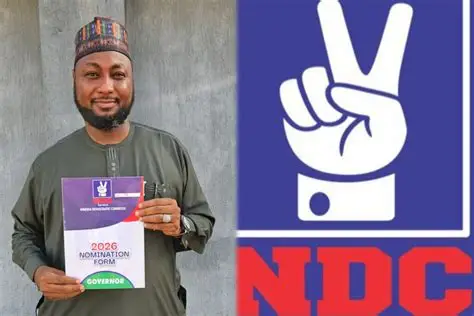
In a hard-hitting exclusive on The Republic Podcast, curated by Njenje Media TV, Ibrahim Abdulkarim says the NDC is mobilising up to 25 people per polling unit, challenges Nigerians to defend their votes, and explains the party’s preparations for the battle ahead.
The Nigerian Democratic Congress (NDC) says it is preparing for the 2027 presidential election with a message that leaves little room for ambiguity: it will not rely on promises, electronic transmission or the goodwill of electoral officials to protect its votes.
Instead, the party says it is building a grassroots monitoring network designed to follow the ballot from the polling unit to the final stages of collation.
In an exclusive and wide-ranging interview on The Republic Podcast, curated by Njenje Media TV, Ibrahim Abdulkarim, Director General of the NDC Presidential Campaign Council, declared that the party had learnt critical lessons from the 2023 election and was determined not to repeat what it considers costly strategic mistakes.
Watch The Full Video:
Speaking with host Great Imo Jonathan, Abdulkarim said the NDC was working to deploy between five and 25 people at polling units, depending on their size, to monitor voting, document results, and follow the collation process.
He said the plan is to ensure the party’s presence does not end when voting closes. Its representatives are expected to remain engaged as results move from polling units to ward, local government and state collation centres.
“We have to make sure that in every polling unit, it is not just having one person, but having at least a cluster of five to 25 people, depending on the size of the people we have at that polling unit,” Abdulkarim said.
His declaration goes to the heart of the opposition’s preparations for 2027. The central question is no longer simply whether Nigerians will vote for change, but whether political parties have built the organisation and capacity to ensure that the votes cast are accurately recorded and reflected in the final results.
‘WE LEARNT FROM 2023’
Abdulkarim said one of the major lessons from the 2023 election was the danger of placing excessive confidence in electronic transmission without adequate grassroots monitoring.
He recalled that opposition supporters had expected polling-unit results to be transmitted electronically to the relevant platform, allowing the public to follow the outcome. But, according to him, the experience exposed weaknesses in the strategy.
The NDC, he said, now intends to combine technology with physical presence, human monitoring and systematic documentation.
The approach is built around a simple proposition: no party should surrender the responsibility of protecting its votes to an electronic platform or assume that the electoral process will take care of itself.
Abdulkarim’s position is that the process must be monitored at every stage, with party agents and supporters prepared to document what happens and challenge discrepancies through the appropriate channels.
For a political movement seeking to build on the support Peter Obi attracted in 2023, the proposed strategy could prove as important as its campaign message.
NDC CHALLENGES INEC, QUESTIONS PUBLIC CONFIDENCE
The interview became particularly forceful when the conversation turned to the Independent National Electoral Commission (INEC) and the controversies surrounding voter registration.
Abdulkarim said the party had raised concerns with the commission over questionable entries and allegations involving images and identities in the voter registration process.
He insisted that the NDC had made formal representations and was seeking answers rather than encouraging public disorder.
The campaign chief, however, acknowledged the depth of public distrust and made clear that the party was not prepared to accept electoral assurances without scrutiny.
He argued that concerns about the credibility of the voter register should be addressed transparently and that Nigerians must be able to examine the process and demand accountability.
At the same time, he warned against allowing controversies surrounding INEC to discourage voters from participating in 2027.
His argument is that abandoning the ballot would only weaken citizens’ ability to demand political change. The opposition, he maintained, must organise, mobilise and monitor the process rather than retreat from it.
The allegations raised during the interview have not been independently established by this report. INEC’s explanations and any relevant documentary evidence remain essential to assessing the claims.
OBI’S ECONOMIC AGENDA: 40,000 CLASSROOMS, 10,000 HOSPITALS
Beyond electoral strategy, Abdulkarim used the interview to defend the economic direction associated with Peter Obi’s proposal to move Nigeria from consumption to production.
He highlighted the proposed construction of 40,000 classrooms and 10,000 cottage hospitals, arguing that these projects would address critical social infrastructure deficits while generating employment and business opportunities across the country.
He estimated that the proposed cottage hospitals could cost between ₦80 million and ₦100 million each, putting the total projected expenditure at approximately ₦1 trillion.
Abdulkarim argued that the investment would not simply produce healthcare facilities. It would also create work for Nigerian contractors, engineers, artisans, bricklayers, masons and other skilled workers.
He presented the proposal as an alternative to what he described as a system in which public resources are spent without sufficiently stimulating domestic production or creating broad-based economic opportunities.
The broader argument is that public expenditure should be judged not merely by the amount spent, but by what it delivers: functioning schools, accessible healthcare, jobs, stronger local businesses and measurable improvements in people’s lives.
The proposed figures and funding assumptions are those cited by the NDC campaign official. Their feasibility will depend on detailed costing, financing arrangements and credible implementation plans.
DEFECTIONS, OPPOSITION DIVISIONS AND THE OBI–KWANKWASO TICKET
Abdulkarim also faced questions about defections, internal disagreements and the departure of prominent political figures from the opposition camp.
He dismissed the suggestion that the movement’s prospects should be judged solely by the presence or absence of particular individuals, arguing that political parties must offer Nigerians a compelling programme and credible leadership.
He maintained that the NDC’s focus remained on presenting its political alternative and consolidating support around the Peter Obi–Rabiu Kwankwaso ticket.
On the question of opposition unity, he suggested that discussions among political actors should be understood within the wider effort to secure a credible electoral environment. He did not present such engagement as an automatic commitment by every opposition figure or party to support one candidate.
The campaign chief also cited a political projection which he said placed the NDC and APC in a competitive position across 13 states each. He referred to a report attributed to Political Intelligence and said it was published on 5 November 2026.
He used the projection to argue that the NDC was more competitive than its critics might assume, particularly given the ruling party’s incumbency and extensive political machinery.
The polling claim, however, remains Abdulkarim’s account of the projection. Its methodology, sample size and underlying data were not independently assessed in the interview.
‘THIS IS NOT ABOUT TRIBE OR RELIGION’
A recurring theme in the conversation was Abdulkarim’s insistence that the 2027 election should be about governance, economic opportunity and accountability rather than ethnic or religious identity.
He argued that young Nigerians want a country in which they can compete globally, access opportunities and build secure futures without being trapped by insecurity, poverty and political patronage.
He also levelled serious criticisms against the Tinubu administration, questioning government spending, public borrowing, contract transparency and the management of national resources.
Those allegations were made by the interviewee and require independent verification against official records, procurement documents and other reliable evidence. The administration’s response is important to a full assessment.
Nevertheless, his broader political argument was clear: Nigerians should judge those seeking power by their record, their policies and their willingness to account for public resources.
THE REAL TEST IS ORGANISATION
The interview leaves the NDC with a significant challenge. Its proposed polling-unit network, candidate-monitoring arrangements and grassroots mobilisation strategy will have to move from campaign declarations to verifiable implementation.
The party must demonstrate that its agents can be recruited, trained, deployed and coordinated across the country. It must also show that its proposed policies can be funded and delivered, while its allegations about the electoral process are supported by evidence.
For voters, the stakes are equally significant. Electoral participation must be matched by vigilance, credible party organisation and institutions capable of protecting the integrity of the ballot.
Abdulkarim’s message is that the opposition cannot afford to repeat the experience of 2023 without changing its approach. Whether the NDC can deliver on its promise will be one of the defining tests of its 2027 campaign.
The conversation on The Republic Podcast, curated by Njenje Media TV, offers a revealing account of the NDC’s thinking as the political contest gathers momentum. It also puts a critical question before Nigerians: if political parties are asking for the people’s mandate, what concrete steps are they taking to ensure that the people’s votes are protected?
The Republic Exclusive. Interview conducted by Great Imo Jonathan. Curated by Njenje Media TV.
Editorial note: Allegations and political assessments in this report are attributed to Ibrahim Abdulkarim. Polling projections, claims about INEC and government conduct, and policy cost estimates have not been independently verified for this publication.