
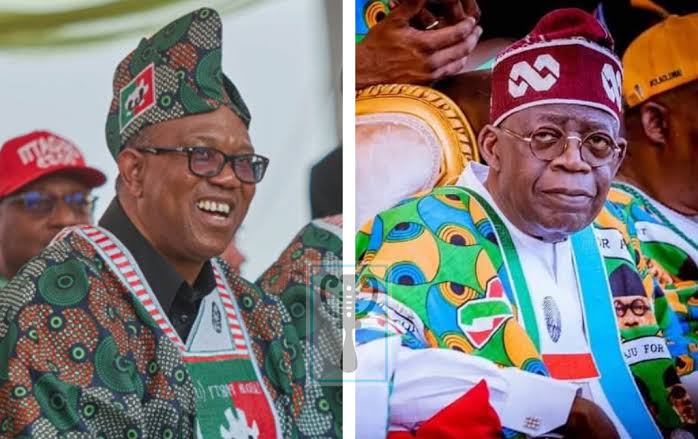
The presidential candidate of the Nigerian Democratic Congress (NDC), Peter Obi, has criticised President Bola Tinubu’s administration over rising poverty and worsening living conditions, insisting that improvements in some macroeconomic indicators do not necessarily translate into better living standards for Nigerians.
Obi, in a statement titled “Celebrating Microeconomic Stability Amidst Increasing Poverty,” said the Federal Government should not interpret recent improvements in economic growth and revenue generation highlighted in a World Bank report as evidence that Nigerians were becoming better off.
According to him, the real measures of economic development are poverty reduction, job creation and a reduction in inequality.
“Nigerians and even the World Bank know that the criteria for economic development is whether poverty is declining, whether jobs are created for our youths, and whether we are reducing acute inequality. In the case of Nigeria under President Tinubu the answer is no,” he said.
The former Anambra State governor argued that the administration’s celebrated economic stability had yet to translate into improved living standards, better employment opportunities or reduced poverty and inequality.
He maintained that an economy could not be considered stable merely because government revenue increased, foreign reserves strengthened or gross domestic product (GDP) grew.
“Stability exists when citizens can afford food, obtain healthcare, provide education for their children, and live with dignity,” Obi stated.
He questioned the practical benefits of increased government revenue to Nigerians struggling to meet basic needs, asking: “What comfort does higher revenue offer a mother who cannot provide her children with a nutritious meal? What does higher government revenue mean to a family forced to choose between purchasing food and paying for medicine?”
Obi also raised concerns about the country’s debt burden, citing figures from the World Bank report titled ‘Beyond the Federal Purse: How Higher Revenues Reshaped State Priorities’.
According to him, the Federal Government spent N7.7 trillion on debt interest payments between January and June 2026, compared with total revenue of N6.2 trillion during the same period.
He said the figures indicated that debt servicing exceeded government revenue by approximately N1.5 trillion, despite the substantial increase in revenue recorded since 2023.
“How do you explain the unsustainable debt crisis even with exponential increase in revenue that we have had since 2023?” he queried.
The NDC presidential candidate further alleged that capital expenditure had declined by about N700 billion in the first half of 2026, despite increases in borrowing and government revenue.
He claimed that the Federal Government was spending approximately 11 times more on interest payments than on capital projects, attributing the situation to what he described as reckless borrowing, corruption and incompetence within the Tinubu administration.
Obi accused the government of placing too much emphasis on economic statistics without adequately addressing their impact on the welfare of ordinary Nigerians.
“President Bola Tinubu and his incompetent team must recognize that intentionally presenting and projecting incomplete economic statistics cannot replace the critical measure of how reform impacts on the welfare of the people,” he said.
He added that Nigerians should not be expected to celebrate official economic figures while struggling with the consequences of government policies.
The former governor also cited a recent United Nations Development Programme (UNDP) report, which he said identified Nigeria among countries where previous gains in poverty reduction had been reversed.
Obi further claimed that approximately 140 million Nigerians were classified as multidimensionally poor, arguing that the figures raised serious questions about the effectiveness of the administration’s economic reforms.
He reiterated his position that economic reforms should be assessed based on their consequences for citizens, particularly the poorest and most vulnerable.
“I have consistently argued that reforms should be evaluated according to their consequences for the people, particularly the poorest and most vulnerable,” he said.
According to him, policies that require Nigerians to make substantial sacrifices must produce visible, measurable and widely shared benefits rather than what he described as misrepresented reports and official celebrations.
Obi urged the Federal Government to use the World Bank’s assessment as an opportunity to review its economic policies and prioritise the welfare of citizens over what he called unfounded self-congratulation.
“The true test is whether Nigerians are eating better, living better, and escaping poverty. The definitive measure of economic success is not the apparent stability of the economy on paper, but the quality of people’s lives,” he stated.
He called for an economy that prioritises citizens’ welfare, tackles mass poverty, reduces inequality and creates sufficient employment opportunities for young Nigerians.
“Nigeria deserves an economy that serves its citizens, not one that continually sacrifices citizens’ wellbeing for ‘macroeconomic stability’, an economy that ends mass poverty, reduces inequality, and creates enough jobs for our youths,” Obi added.
He concluded with the declaration: “A New and Productive Nigeria is POssible. Nigeria will be OK.”