

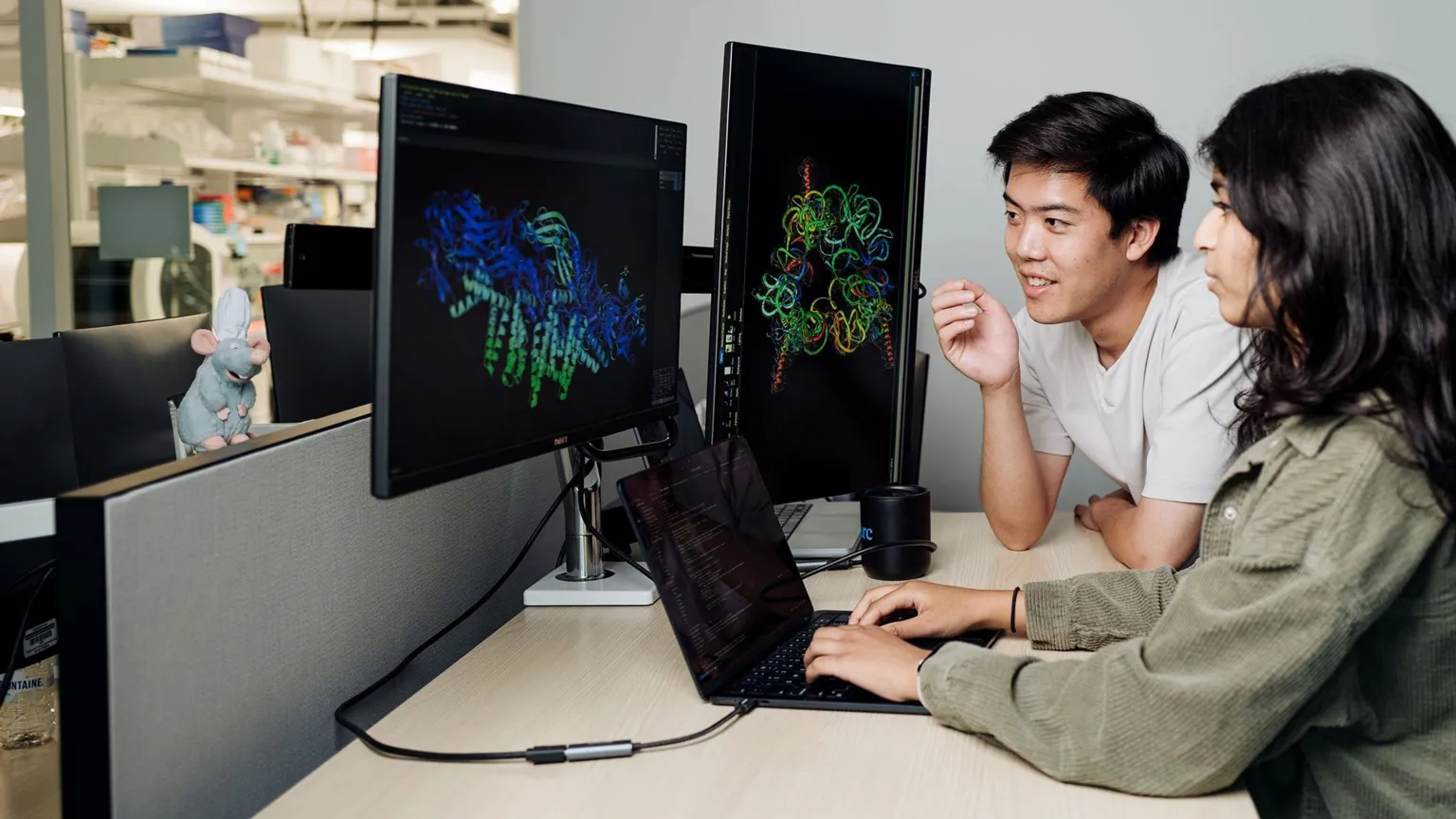
Scientists in the United States have used artificial intelligence to design 16 previously unknown viruses that were successfully created and shown to replicate in laboratory conditions.
The viruses were designed to infect bacteria and pose no known threat to humans. Researchers say the achievement marks the first successful use of AI to design complete viral genomes.
Brian Hie, an assistant professor at Stanford University, described the development as a major step in what generative AI can create.
“This is a next step in the complexity that’s designable by generative AI, this is the first time generative AI has been used to design a complete genome, it’s something that can replicate and have other functions inside cells… this was new territory for us,” Brian Hie, assistant professor at Stanford University, told the BBC.
The research used AI models called Evo1 and Evo2, which were trained on genetic sequences from viruses, bacteria, plants and humans. Rather than predicting words like conventional large language models such as ChatGPT, the systems were trained to predict biological sequences.
Researchers then used the models to generate bacteriophages, viruses that specifically infect bacteria. Of 302 AI-generated designs selected for laboratory testing, 16 successfully killed E. coli bacteria.
Samuel King, a PhD student involved in the research, said the team realised the designs were working when they began observing clear areas on laboratory plates where bacteria had been destroyed.
“We were starting to see these clear spots and it was just extremely exciting,” says King.
When the findings were presented to the wider research team, “the room spontaneously burst into applause”, Hie recalls.
The researchers believe AI-designed bacteriophages could eventually help develop new treatments for bacterial infections that have become resistant to existing antibiotics.
However, the development has also raised concerns about the potential misuse of AI in synthetic biology. Experts warn that similar technologies could eventually be applied to biological systems capable of causing harm.
In a commentary published alongside the study in the journal Science, Dr Thomas Inglesby and Dr Moritz Hanke of the Center for Health Security at Johns Hopkins University said the findings raised “urgent biosafety and biosecurity questions”.
They argued that the debate was no longer about “whether generative viral genome design will exist” but whether it can be used without “enabling serious harm”.
They also warned that viruses capable of causing disease “should not be pursued”.
The Stanford researchers said they incorporated several safeguards into their work. Their training database excluded viruses capable of infecting complex organisms, while the experiments focused exclusively on bacteriophages rather than viruses that infect humans. The research was also conducted in a secure laboratory.
Hie said existing safeguards could play an important role in “ensuring that the technology is used for good”.
The researchers stressed that designing a living organism remains considerably more difficult. The bacteriophage genomes used in the study contain about 5,400 base pairs, compared with roughly 500,000 base pairs in the smallest genome of a living cell and about three billion base pairs in the human genome.
Hie said creating simple organisms with AI “would probably be a lot of work, but not impossible” and added that the researchers were “definitely interested in working towards” it.
Prof Marc Güell of Pompeu Fabra University in Spain described the study as a “very significant turning point”, saying that for the “first time in history, we are beginning to design biology on a computer”.
He said the technology “allows us to dream of exciting possibilities for tackling humanity’s greatest challenges”, including developing bacteriophages against disease, enzymes for treating genetic disorders and antibodies for immunotherapy.
Prof Patrick Cai, chair of synthetic genomics at the Manchester Institute of Biotechnology, called the research an “important milestone”.
“The significance extends far beyond phages – it suggests that genome language models are beginning to learn the design principles encoded by evolution, opening the door to AI-assisted genome writing.”