

With about a month remaining before Election Day, more than 700,000 Americans have already cast ballots across at least 30 states, with early voting figures showing signs that Democrats are currently more successful in mobilising voters.
In several states featuring competitive Senate or gubernatorial contests this fall, Democrats account for a higher proportion of ballot requests than they did at the same stage of the 2024 election cycle.
In Iowa, Democrats account for 67% of ballot requests, compared with 54% at the same point in 2024. Pennsylvania has recorded 66%, up from 62%, while Maine stands at 57%, compared with 53% previously. North Carolina data also shows Democrats accounting for 42% of ballot requests, up from 36% two years ago.
However, the figures are not uniformly higher than previous election cycles. In all the states mentioned except Iowa, the Democratic share of ballot requests at this stage in 2022 was higher than the current figure.
The increase in Democratic ballot requests is consistent with polling, special election outcomes and primary turnout, which have indicated greater Democratic voter motivation heading into November.
The figures could also reflect a continuing shift among Republican voters toward other methods of casting their ballots.
Importantly, early voting figures do not reveal which candidates or parties voters supported because ballots are secret. Although whether someone has voted is generally public information, the actual vote remains confidential. Final vote totals will only become known when states begin releasing results after polls close on November 3.
Early voting data also represents only a segment of the electorate and tends to include older voters while being less representative of Republicans overall.
Older Voters Increasingly Prominent Among Early Voters
Voting patterns have changed considerably since the Covid-19 pandemic, with mail voting declining from its 2020 peak while voters aged 65 and above have represented an increasing proportion of mail voters.
According to CNN Exit Poll data, voters aged 65 and older accounted for 27% of mail voters in 2020, rising to 31% in 2022 and 37% in 2024.
The trend is partly unsurprising because mail voting can provide greater convenience for older voters who may find travelling to polling stations difficult. In states requiring an excuse for voting by mail, age can also qualify voters for mail ballots.
Early figures suggest the trend is continuing in 2026. In nearly every state with comparable figures, voters aged 65 and older account for a larger proportion of ballot requests than they did at the same stage in either 2022 or 2024.
Virginia Shows Strong Democratic Early-Voting Numbers
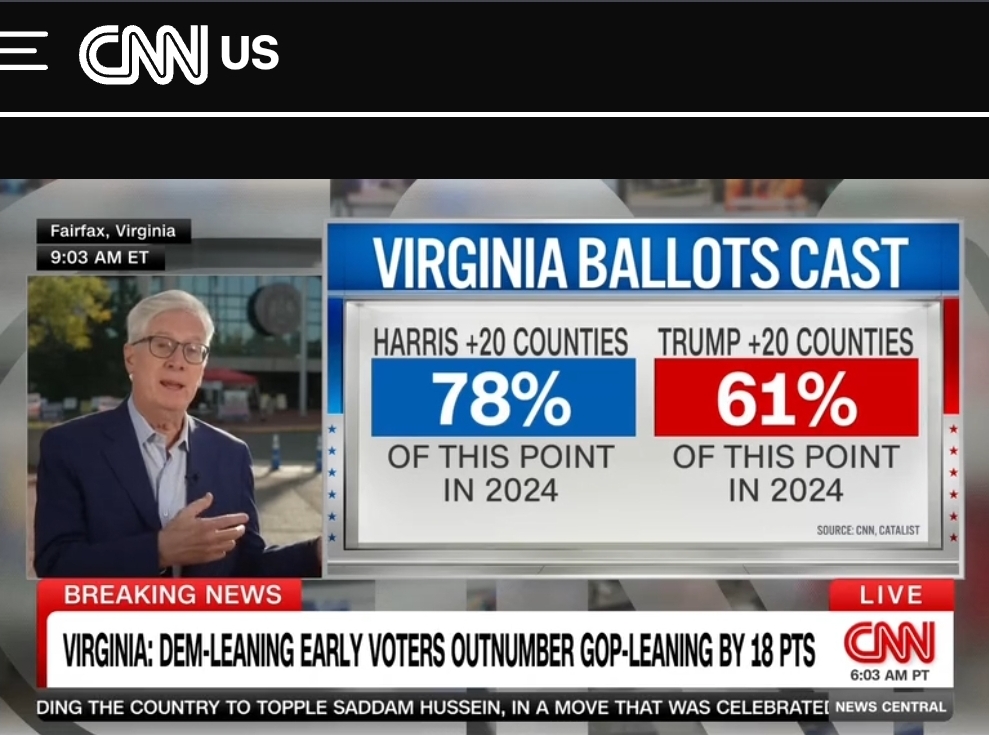
Some of the strongest early indications for Democrats have emerged from Virginia, which has reported the largest number of votes in CNN’s count and is currently the only state to have provided substantial figures for both early in-person and mail voting.
Although Virginia voters do not register by political party, early voting patterns correspond closely with how localities voted in the 2024 presidential election.
Cities and counties where former Vice President Kamala Harris won by more than 20 percentage points have reached 78% of their turnout from the same period in 2024. By comparison, areas where President Donald Trump won by 20 points have reached 61%.
Partisan turnout, measured by voters who have participated exclusively in one party’s primaries since 2022, also points to a significant Democratic advantage compared with the same point in 2024.
However, Republicans could narrow the difference as Election Day approaches. Virginia is still in the early stages of voting, having recorded more than 4.5 million votes in 2024 and over 3.4 million in 2025. The state’s Senate race is not expected to be highly competitive this year, while Republican voters could show greater motivation in closely contested races.
Two competitive House races in Virginia nevertheless show increased Democratic participation.
Democratic primary participants currently outnumber Republican primary participants by 15 percentage points among voters in the 1st Congressional District and by 18 points in the 2nd District. Both districts are considered battlegrounds and are represented by Republicans facing strong challengers, including Rep. Rob Wittman in the 1st District and Rep. Jen Kiggans in the 2nd.
At the same stage in 2024, the partisan composition was much closer. Republican primary voters led by approximately three points in the 1st District, while Democratic primary voters held a two-point advantage in the 2nd.
Across Virginia, Democratic primary participants currently lead Republicans by approximately 18 points, compared with an eight-point Democratic advantage at the same stage in 2024.
Early Voting Figures Have Limitations
Pre-election voting data provides useful insight into voting patterns but has important limitations.
The early voting figures are compiled by CNN, the Associated Press and Catalist, a data and analytics company that provides services to Democrats, academics and nonprofit advocacy organisations.
The number of ballots cast so far represents only a small portion of the roughly 57 million pre-election votes recorded in 2022 and an even smaller fraction of the approximately 112 million total votes cast that year. The number is expected to rise significantly over the coming weeks.
The current data is also dominated by mail ballots because only a limited number of states have begun substantial early in-person voting. In recent election cycles, mail voters have tended to be more Democratic, while early in-person voters have generally been more evenly divided or leaned Republican.