

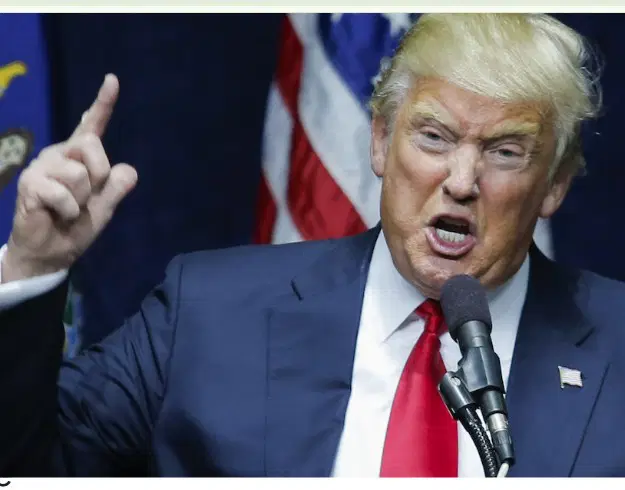
IRAN’S PROXY OFFENSIVES AS A DETERRENCE STRATEGY AGAINST DONALD TRUMP’S BULLYING
By Prof. Femi Olufunmilade
Director, Buratai Center for Contemporary Security Affairs, Igbinedion University Okada, Edo State, Nigeria.
Email: director.bccsa@iuokada.edu.ng
—————————————————-
The erratic foreign policy of President Donald Trump — defined by unilateral tariffs as weapons of coercion, public threats of regime change on social media, the abrupt withdrawal from and return to international agreements, the transactional use of military bases, and the open bullying of allies and adversaries alike — has reached its limits in the Persian Gulf. From imposing 100% tariffs on allies who refuse to endorse his Middle East wars, to threatening to seize shipping lanes and annex strategic territories, to ordering strikes on Iran without congressional authorization while demanding that Gulf states pay for their own protection, Trump has turned American statecraft into a spectacle of intimidation. The recent confrontation between the United States and the Islamic Republic of Iran has shattered the core premise of this approach: that overwhelming military dominance and economic blackmail alone can compel obedience. Iran’s calibrated response, especially over the control of the Strait of Hormuz, has demonstrated that strategic calculation, geographic leverage, and an indigenous military-industrial complex can neutralize the advantage of the best-armed military in the world.
Undoubtedly, the United States possesses unparalleled conventional superiority. Yet in the Strait of Hormuz, through which nearly 21% of global oil passes, Tehran has shown that dominance of a geopolitical chokepoint requires more than aircraft carriers. By deploying asymmetric assets — coastal anti-ship missiles, fast-attack craft swarms, smart mines, and long-range drones produced entirely within its indigenous defence industry — Iran imposed disproportionate costs on what is turning out to be a misadventure at the behest of an American president deserving of a Nobel Prize for overreach. Iran’s is not a rentier military dependent on foreign supply chains; it is a self-sustaining complex that has learned under sanctions to produce Shahed drones, Fateh missiles, and Mersad air defence systems. The lesson is clear: strategic geography plus industrial self-reliance equals effective deterrence.
*US Military Bases As Liabilities*
For decades, Gulf monarchies anchored their security on the presence of American bases in Qatar, Bahrain, Kuwait, Saudi Arabia, and the UAE. Iran’s ability to assert control over Hormuz and to strike with precision across the region has demystified that guarantee. The Al-Udeid, Fifth Fleet, and other installations, once seen as shields, are now understood as magnets. When the United States embarked on its military misadventure against Iran, host nations found themselves immediately in harm’s way, their oil terminals, airports, and desalinization plants within range of Iranian retaliation. This has exposed the fundamental inadequacy and vulnerability of the United States as a reliable protective ally. The protection offered is conditional, escalatory, and ultimately serves American interests first. The presence of a US base no longer assures invulnerability; it ensures entanglement.
*The Search for Survival via Alternatives*
Disappointed American allies left in the cold are now actively seeking additional, if not alternative, military support outside the American umbrella. This entails a rush for war-tested Ukrainian drones and new defence pacts. Saudi Arabia, through its SAMI defence conglomerate, has signed a reported $1.2 billion co-production agreement with Ukrainian firm Ukrspecsystems for PD-2 and Shark reconnaissance-strike UAVs with assembly in Riyadh, including technology transfer for 1,200km range one-way attack drones. The United Arab Emirates, through EDGE Group, has concluded a joint-development deal with Kyiv’s Fire Point for FP-1 long-range kamikaze drones with 1,600km range and 105kg warhead, now test-flown in the Liwa desert as a low-cost substitute for delayed American MQ-9 Reapers. Qatar, Kuwait, Egypt and Morocco have similarly procured Ukrainian UJ-22, UJ-26 Bober and Magura V5 maritime drone derivatives to secure Red Sea and Mediterranean shipping after American naval protection proved insufficient against Houthi interdiction. The appeal is clear: Ukrainian drones are 70-80% cheaper than American systems, carry no political end-use restrictions, and are proven against S-300 and Pantsir systems. Parallel to this, Saudi Arabia has fundamentally rebuilt its defence architecture beyond Washington. In November 2025, Riyadh and Islamabad signed a formal Strategic Mutual Defence Agreement ratified by Crown Prince Mohammed bin Salman and Prime Minister Shehbaz Sharif, providing for joint operational planning, deployment of Pakistani JF-17 Block III squadrons to Tabuk, and nuclear consultation, with Pakistan’s Army Chief declaring that an attack on Saudi Arabia is an attack on Pakistan. At the same time, Saudi Arabia has become Turkey’s largest defence market, with a $3.1 billion procurement of 60 Bayraktar AKINCI HALE drones with a production line in King Khalid Industrial City, co-production of TAI KAAN fifth-generation fighter components and HISAR-O medium-range air defence to replace failing American Patriot batteries, and joint development of ROKETSAN SOM cruise missiles. This is complemented by finalization of HQ-9B and HQ-17AE systems from China and KM-SAM II from South Korea after the US Congress blocked additional THAAD interceptors. The UAE has mirrored this with major Rafale deals from France and deep cooperation with Turkey and South Korea, while Egypt and Bahrain are exploring Russian and Chinese air defence. What we are witnessing is the structural unraveling of a 50-year American monopoly, directly triggered by the realization that an American base is a liability that invites retaliation without guaranteeing protection.
*The Strategic Essence of the Proxy Network*
The core of Iran’s deterrence architecture, aside the resilience of its domestic manufacturing of weapons, is its network of allied resistance forces — a doctrine of forward defence perfected over four decades. When Israel and the United States began their recent combined attacks on Iranian nuclear and command infrastructure, Hezbollah’s intervention in northern Israel was immediate and calculated. By launching coordinated rocket and anti-tank guided missile barrages across the Galilee, targeting radar stations and Iron Dome batteries, Hezbollah forced the Israeli Defence Forces to divert two divisions from an offensive posture to border defence, stretching Israeli air defence capacity to breaking point. This logic reached its climax with the latest Houthi offensives on Saudi Arabia. In a graphic demonstration of extended deterrence, Ansarullah forces launched simultaneous waves of long-range Quds-2 cruise missiles and Samad-3 drones against Aramco’s Abqaiq processing facility, Ras Tanura export terminal, and Yanbu refinery. The precision strikes caused fires that shut in over 3.5 million barrels per day of Saudi processing capacity for weeks. Tanker traffic through the Red Sea was simultaneously threatened with anti-ship ballistic missiles, forcing Lloyd’s to raise war risk premiums by 400%. The economic shockwave was instantaneous. Brent crude spiked from $78 to $142, triggering cascading supply chain disruptions. In Europe, truckers and farmers mounted protests from Berlin to Paris to Warsaw as diesel prices doubled. In the United States, the discomfort was acute. To prevent a trucking collapse and electoral backlash, the Trump administration was compelled to announce an emergency diesel subsidy package of up to $8 billion, while quietly removing secondary sanctions restrictions to allow importation of Russian diesel to stabilize the East Coast market. This paradox — punishing Russia while being forced to import its diesel to survive Iranian proxy pressure — underscores the cost of miscalculation.
*Deterrence: Making Future Attacks Too Expensive*
The core of Iranian strategic deterrence lies in making future attacks too expensive for the US and its co-travellers, if any. By weaponizing oil supply disruption through its proxies and demystifying American power, Iran has made the recent attacks on it prohibitively costly for the global economy. The most graphic illustration of this new cost is the recent pummelling of Saudi Arabia by the Houthis, a direct response to Riyadh’s logistical facilitation of American operations.
The offensive unfolded in three interlocking layers. First, the oil infrastructure was systematically degraded. On successive nights, swarms of 25-30 Samad-3 suicide drones and Quds-2 cruise missiles struck Abqaiq — the world’s largest crude stabilization plant — igniting spheroid tanks and forcing a complete evacuation of foreign contractors. At Ras Tanura, the Sea Island loading platform, which handles 90% of Saudi exports, was hit by two anti-ship ballistic missiles, setting a VLCC supertanker ablaze at berth and suspending all loading for 11 days. The Yanbu Aramco Sinopec refinery and the Jubail petrochemical complex suffered similar strikes, cutting refined product output by 40%.
Second, aviation and civilian infrastructure was paralyzed. Abha International Airport, Jizan Airport, and King Khalid International Airport in Riyadh were repeatedly struck by Burkan-3 ballistic missiles and Kasef-2K drones. At Abha, the air traffic control tower and runway were damaged, with shrapnel ripping through a parked Flynas A320, forcing NOTAM closure for 72 hours. At Jizan and Najran, military-civilian dual-use airfields were hit, destroying a Saudi F-15SA shelter and two Apache helicopters on the ground. Passenger terminals were filled with smoke, flights diverted to Jeddah, and international carriers suspended operations to southern Saudi Arabia.
Third, military assets were directly degraded. The Houthi strikes targeted King Faisal Air Base in Tabuk, the Patriot PAC-3 battery sites at Khamis Mushait, and the RSAF radar station at Al-Duwadmi. Open-source imagery showed a direct hit on a Patriot radar engagement section and the destruction of fuel depots and munitions warehouses, with secondary explosions visible for hours. The cumulative effect was a nationwide blackout of air defence in the southwest, forcing Riyadh to redeploy its limited THAAD interceptors from the Gulf coast, leaving oil assets exposed.
This three-tiered pummelling — oil, airports, and military assets — demonstrated that Saudi Arabia could be economically strangled and militarily blinded without a single Iranian soldier crossing the border. The cost is no longer measured in missiles expended, but in oil price shocks, inflationary spirals, European unrest, and American domestic subsidy burdens. This deterrence is therefore not anchored on economic punishment alone, but on political destabilization that puts pressure on the whole world. The protests that have erupted across Europe are directly connected to the Iranian disruptions. In France, the gilets jaunes-style blockades returned as hauliers shut down the A6 and A7 autoroutes over diesel at €2.70 per litre. In Italy, farmers and transport unions staged coordinated strikes in Milan, Naples and Turin, shutting down fuel depots. In Serbia, Albania, Greece, and even the United Kingdom, mass demonstrations against energy prices and cost-of-living have been triggered by the same supply chain shock initiated in Hormuz and the Red Sea. Governments that supported or tolerated American misadventure are now facing domestic legitimacy crises, forced to choose between their alliance with Washington and survival at home. This political cost is far more potent than any economic figure. Future war planners in Washington must now factor in not just Iranian missiles, but a $150 oil price, Red Sea closure, airport closures, burning refineries, allied revolt, and continent-wide street protests demanding an end to American wars in the Middle East. That is a price no administration can easily pay. The proxy offensive has therefore achieved what direct conventional parity could not: it has made the likelihood of future attacks on Iran terrifyingly expensive and strategically irrational. This will likely discourage any future attacks on Iran. This, not American restraint, is what guarantees peace. Deterrence has been restored — not by American bullying, but by Iranian strategic depth.
Hopefully, those who were glorifying the attacks on Iran as a noble venture aimed at dislodging a regime accused of terrorism from power are being wizened up by the patent reality unfolding.