
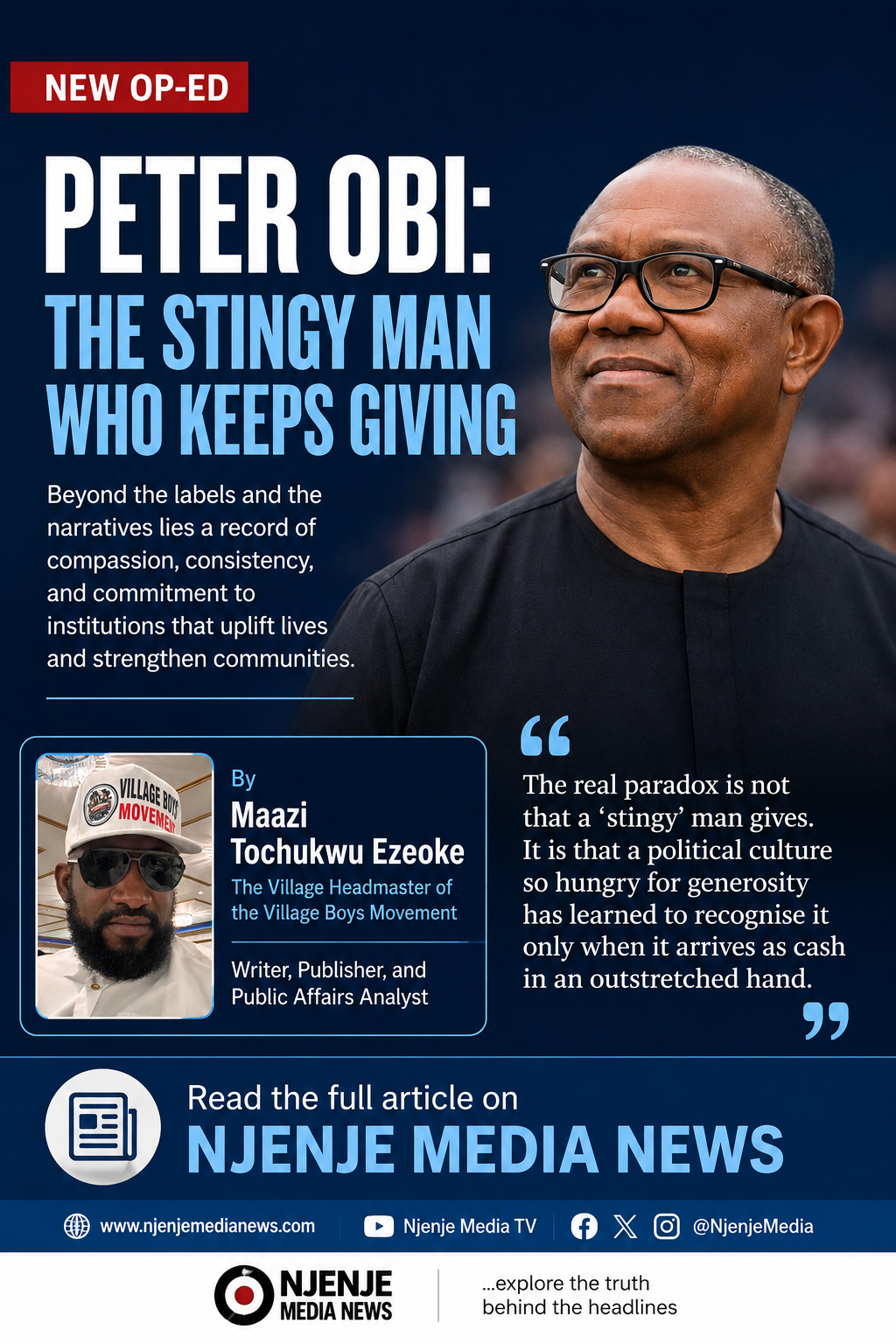
Peter Obi: The Stingy Man Who Keeps Giving
By Maazi Tochukwu Ezeoke
Political labels often reveal less about the people they describe than about the societies that create them. Few labels in contemporary Nigerian politics illustrate this better than the enduring characterisation of Peter Obi as “stingy.” It is a description repeated so frequently that it has acquired the force of conventional wisdom. Yet it collides headlong with an inconvenient reality, a documented record of sustained multimillion-naira interventions in hospitals, nursing schools, universities, humanitarian organisations, churches and community institutions across Nigeria.
How does a man persistently caricatured as stingy leave behind a trail of educational endowments, healthcare donations and institutional support that spans decades? How does the politician forever associated with the phrase, “I no dey give shishi,” emerge as one of Nigeria’s most consistently documented private benefactors of public institutions? The contradiction deserves closer examination, not merely because it concerns one individual, but because it exposes the moral economy of Nigerian politics.
Peter Obi’s reputation for stinginess did not emerge because he lacks generosity. It emerged because he refuses to practise the particular form of generosity that Nigeria’s political culture has come to expect and celebrate.
In much of Nigerian politics, generosity is measured not by the number of lives transformed but by the speed with which cash changes hands. Political loyalty is cultivated through envelopes. Party structures are lubricated with patronage. Religious endorsements are often expected to attract financial rewards. Crowds gather at campaign rallies anticipating not ideas or policy, but cash distribution. Influence itself has become transactional.
Against this backdrop, Obi’s famous declaration, “I no dey give shishi,” was never simply a statement about money. It was a rejection of a political philosophy, the belief that public trust can be bought, that political support must be rented, and that leadership is validated through financial inducement rather than competence and integrity.
Such a posture was always destined to appear abnormal in a political environment where abnormality has become normal. In Nigeria, refusing to participate in patronage is frequently interpreted not as principle but as miserliness.
Yet away from the political theatre exists another Peter Obi, one whose philanthropy has been directed not towards individuals seeking immediate gratification but towards institutions capable of producing long-term public value.
Across Nigeria, hospitals have received medical equipment and financial support. Schools and universities have benefited from infrastructure and development funding. Nursing colleges have been strengthened through private donations. Faith-based organisations engaged in education and healthcare have repeatedly acknowledged his interventions. Communities have benefited from projects that receive little publicity because they are designed to solve problems rather than generate headlines.
There is an important distinction here. Obi’s giving is largely institutional rather than transactional. It seeks to strengthen systems instead of cultivating clients. It invests in classrooms rather than crowds, in hospital wards rather than political war chests, in future generations rather than fleeting applause.
This distinction explains why the stingy label has proved remarkably durable.
Many who perpetuate it have never personally received anything from him. In a political culture conditioned to expect immediate personal benefit, generosity that benefits the public without directly benefiting the individual often feels invisible. The hospital patient who receives better treatment because new equipment was donated rarely dominates political conversations. The student studying in an improved learning environment seldom becomes a political influencer. The community whose healthcare infrastructure has been strengthened rarely controls the national narrative.
The loudest voices often belong to those whose expectations of personal patronage went unmet.
Their grievance is not necessarily that generosity is absent. It is that generosity was not personalised.
Herein lies one of the great ironies of Nigerian public life.
Politicians who deploy public resources recklessly to finance patronage networks are celebrated as generous. Those who distribute cash during election campaigns are praised as compassionate. Those who mortgage the future to satisfy today’s political demands are regarded as men of the people.
Conversely, those who insist on fiscal discipline, reject vote-buying, refuse to purchase endorsements and channel private resources towards enduring public institutions are frequently dismissed as stingy.
The language itself has been inverted.
Prudence is mistaken for poverty of spirit.
Discipline is confused with indifference.
Integrity becomes evidence of selfishness.
It is a remarkable moral reversal, and one that says more about the incentives embedded within Nigeria’s political culture than it does about the character of those being judged.
None of this places Peter Obi beyond criticism. Philanthropy is not a substitute for sound governance, nor should charitable giving exempt any public figure from rigorous scrutiny. Democratic leadership must ultimately be assessed by vision, competence, accountability and policy outcomes rather than acts of private generosity.
But intellectual honesty demands that narratives be tested against evidence.
A public figure whose private resources have repeatedly strengthened hospitals, educational institutions and humanitarian causes cannot be honestly reduced to the simplistic caricature of stinginess merely because he refuses to distribute cash for political convenience.
Perhaps the real paradox is not that a supposedly stingy man keeps giving.
Perhaps the deeper paradox is that a political culture desperately yearning for good leadership has conditioned itself to recognise generosity only when it arrives as cash placed directly into waiting hands.
That expectation lies at the heart of Nigeria’s patronage crisis.
If generosity is judged solely by the number of people who receive immediate personal benefit, then those who build institutions instead of client networks will almost always lose the public relations battle to those who purchase loyalty.
Nigeria’s greatest deficit may therefore not be the scarcity of generous leaders.
It may be the scarcity of a civic culture capable of recognising generosity when it is expressed through institutions instead of inducements, through investments instead of handouts, and through nation-building rather than political transaction.
Until that changes, the country will continue to mistake patronage for compassion, expenditure for generosity, and integrity for stinginess.
And perhaps that is the greatest irony of all.
Maazi Tochukwu Ezeoke
The Village Headmaster of the Village Boys Movement