
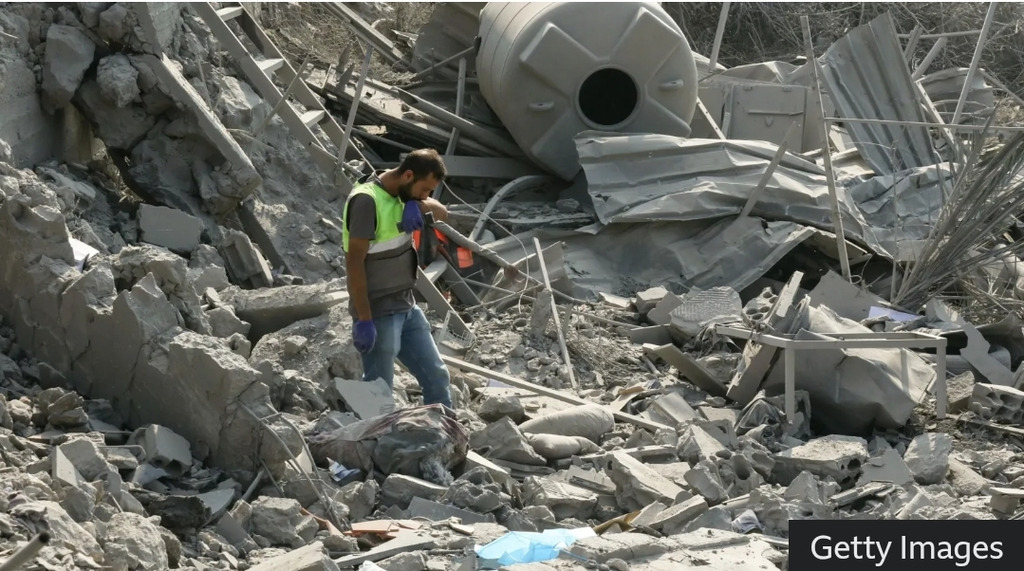
Eleven people have been killed in Israeli strikes across southern Lebanon, authorities said, marking one of the deadliest days of attacks since an agreement aimed at reducing hostilities was announced in June.
Lebanese Prime Minister Nawaf Salam said seven people were killed when an Israeli strike hit a house on the outskirts of Ansar, about 70km (43 miles) south of Beirut. State media reported that three children and two women were among those killed.
The Israel Defense Forces (IDF) said the strike killed a Hezbollah commander following an attack on Israeli soldiers. The military also claimed the commander’s family, “who he used as human shields”, were present and “harmed”.
Later on Saturday, another series of Israeli strikes hit Deir al-Zahrani, killing four people and injuring five others, according to Lebanon’s Ministry of Health.
Lebanese authorities said the strike on Ansar occurred at about 04:30 (01:30 GMT) in an area where displaced families were staying. Footage shared on social media showed thick smoke spreading through the village as sirens sounded.
Salam condemned the attack, insisting that the seven civilians killed were not “military infrastructure”.
“Israel must halt this escalation,” he said. “For the security of our people and their right to life on their land are not subject to negotiation or bargaining.”
The IDF said the incident that triggered the strike took place in the Ali al-Taher Ridge, a strategically important elevated area overlooking much of south-eastern Lebanon and one of the most heavily contested positions during the conflict.
In a subsequent statement, the IDF identified the Hezbollah commander killed as Ali Samir al-Haj Hassan, whom it described as a battalion commander with the group’s Radwan Force unit.
“Alongside him, several additional terrorists who were involved in advancing terror attacks against IDF soldiers were eliminated,” the statement said.
The IDF said the strike specifically targeted Hassan, whom it described as a lawful target under international law, rather than his family.
“The strike was specifically directed at Hassan, who was a lawful target under international law, not at his family members who he used as human shields – hiding alongside them inside the military HQ,” the military said.
Lebanon became involved in the wider conflict between Israel, the United States and Iran on 2 March, after Hezbollah, an armed group backed by Iran, fired rockets into Israel in retaliation for an attack that killed Iran’s supreme leader.
Israel responded with an extensive bombing campaign across Lebanon and a ground invasion of large parts of southern Lebanon. Israeli forces still occupy about 5% of Lebanese territory.
The ceasefire framework announced in June requires Hezbollah to disarm, Israeli troops to gradually withdraw from southern Lebanon and the Lebanese army to deploy throughout the area.
Lebanese President Joseph Aoun condemned the Israeli strikes that killed an entire family in Ansar, as well as what he described as Israel’s “repeated violations” of the agreement.
He said the attacks sent a “clear message” to the US-led negotiations.
Hezbollah was not a party to the agreement and has rejected direct negotiations with Israel.
“The Israeli enemy must clearly understand that its attacks, violations and attempts to impose a fait accompli cannot continue, and will be met with an appropriate response in defense of Lebanon, its people, sovereignty and national dignity,” the group said in a statement on Saturday.
The IDF said it would continue taking action against threats to Israeli civilians and soldiers operating within the security zone, a military buffer extending 10km into southern Lebanon and currently occupied by Israel.
Although fighting has declined since the June agreement, Israeli airstrikes and demolitions in southern Lebanon have continued.
Lebanese and Israeli negotiators are expected to hold their eighth round of talks in September, although a specific date has yet to be announced.