

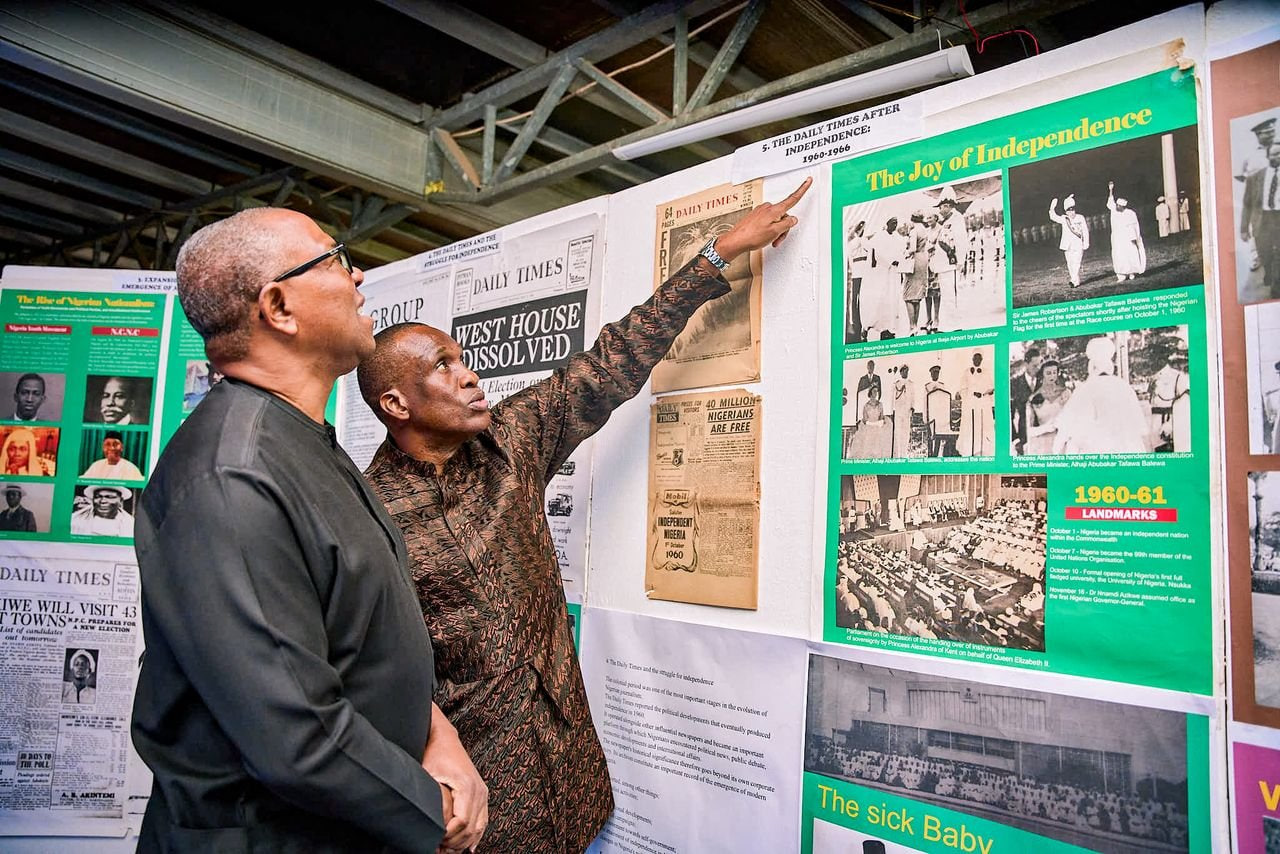
The Presidential Candidate of the Nigeria Democratic Congress (NDC), Peter Obi, has expressed concern over the decline of major Nigerian institutions that once played significant roles in the country’s economic and social development.
Obi spoke on Thursday after attending the 100th anniversary celebration of the Daily Times newspaper in Abuja, where he reflected on Nigeria’s history and the performance of institutions established in the country’s early years.
Recalling his childhood, Obi said his visits to newspaper stands in Onitsha helped shape his interest in governance, the economy and national development.
He said an exhibition of old Daily Times publications at the anniversary event reminded him of institutions that had once demonstrated Nigeria’s capacity for growth.
According to Obi, one of the exhibits was an advertisement for the Nigerian Shipping Line, which had six ships in 1959, eight in 1960 and 10 by 1961.
He noted that more than six decades later, the Nigerian Shipping Line no longer operates any ships.
Obi also recalled the history of Nigerian Airways, which commenced operations in 1958 and had by 1980 developed into one of Africa’s leading airlines, operating more than 30 aircraft and direct flights to several international destinations.
He said the airline eventually ceased operations in 2003.
Obi compared the former Nigerian national carrier with Emirates, which began operations in 1985 with two leased aircraft but has since grown into a major global airline with more than 250 aircraft.
He described the comparison as a reminder of Nigeria’s failure to sustain institutions and investments established by previous generations.
“These are not merely stories from old newspapers. They are reminders of what Nigeria once built, what our people were capable of achieving, and, most importantly, what we failed to sustain,” Obi said.
He attributed the decline of several Nigerian institutions to what he described as years of “poor leadership, mismanagement, corruption, and weak accountability.”
Obi also expressed concern that while several national institutions had weakened or disappeared, corruption appeared to have persisted and expanded.
“Even more painful is the fact that while many of our institutions have weakened or disappeared, corruption seems to have remained one of the few things that has continued to grow,” he said.
The former Anambra State governor said Nigerians must examine why institutions that once functioned effectively had deteriorated and why countries that were once behind Nigeria had overtaken it in several areas of development.
He said the lessons from Nigeria’s past should inform the decisions being made today.
Obi commended Daily Times Chairman, Fidelis Anosike, and his team for preserving the newspaper’s legacy and keeping an important part of Nigeria’s history accessible to present and future generations.
“A nation that forgets its history risks repeating its mistakes,” he said.
Obi called for stronger institutions capable of surviving individual leaders and political administrations, saying Nigeria could reverse its decline through competent and accountable leadership.
“Nigeria is not condemned to decline,” he said, adding that the country could rebuild its institutions, restore confidence in government, develop a productive economy and establish enterprises capable of competing globally.
He said the country must ensure that future generations inherit stronger institutions, greater opportunities and a better quality of life.
“The Nigeria we desire is possible. But it requires leadership anchored on competence, accountability, prudence, integrity, and service,” Obi said.
He urged Nigerians to move beyond celebrating the country’s past achievements and focus on rebuilding institutions and systems capable of delivering sustainable development.
“We must stop celebrating what Nigeria used to be and start rebuilding what Nigeria can become,” he said.
Obi concluded by declaring that the rebuilding of Nigeria must begin immediately.