
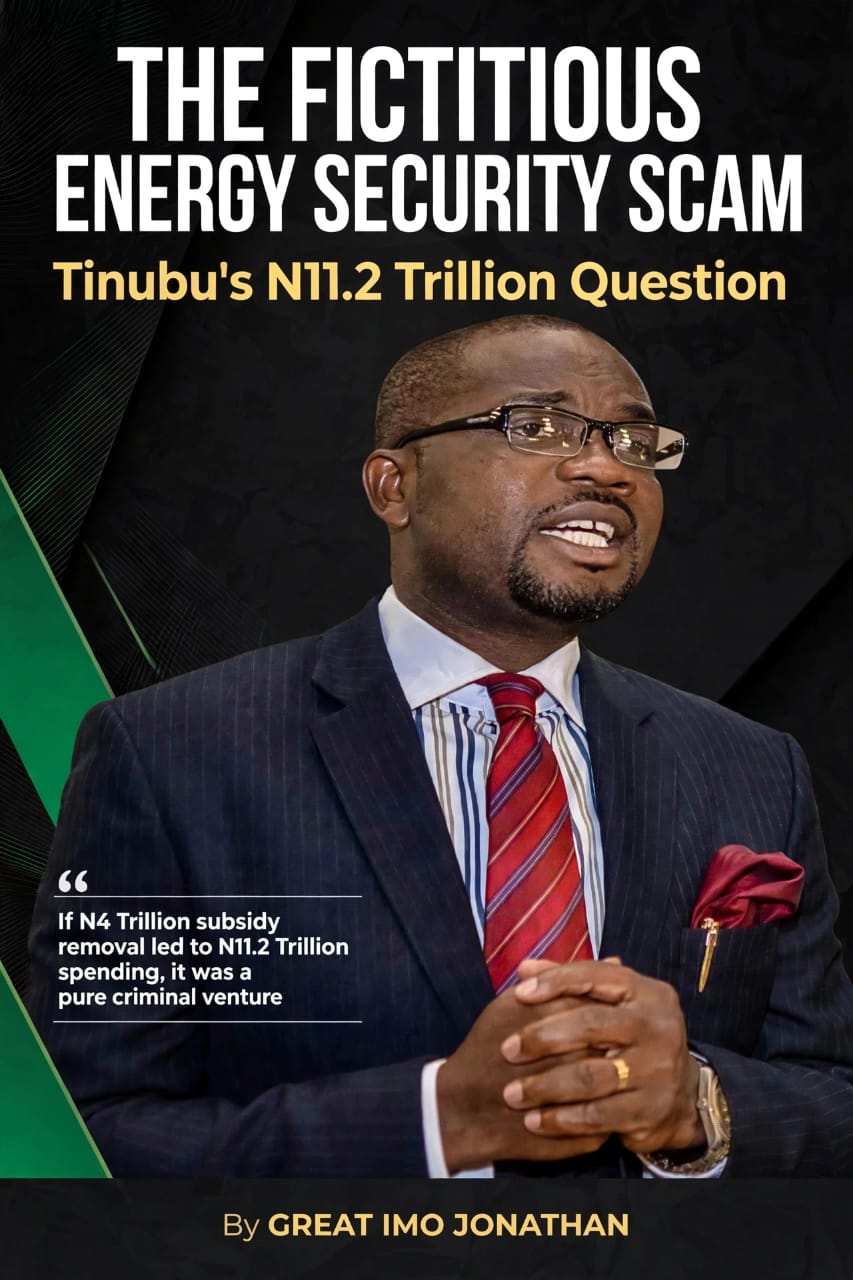
*THE FICTITIOUS ENERGY SECURITY SCAM: TINUBU’S N11.2 TRILLION QUESTION*
Great Imo Jonathan
If President Tinubu removed 4 Trillion subsidy for poor people and even the corrupt elite and ended up spending 11.2 Trillion on fictitious energy security then it was a pure criminal venture.
The fuel subsidy removal of May 29, 2023, was sold to Nigerians as a painful but necessary surgery. President Bola Ahmed Tinubu declared “subsidy is gone” and his supporters argued that the country was spending over N4 trillion annually to subsidize the rich and feed a corrupt cartel. Every Nigerian agreed that it has to go. Almost all presidential candidates agreed as well. Although Peter Obi talked about removing the corruption associated with subsidy first, and then implement structural and gradual removal of it while providing a good alternative to citizens.
Nigerians were asked to tighten their belts, endure N600, N900, and then over N1,400 per litre, and believe that the savings would rebuild the nation.
If we accept the government’s own figures, the story was simple: We were spending about N4 Trillion on subsidy. That money would now be saved and channeled into infrastructure, education, health, and direct support for the poor.
What has emerged two years later is not savings, but a financial black hole that makes the old subsidy regime look like petty theft.
Reports from the public accounts, FAAC disclosures, and investigative media now show that the Tinubu administration has spent a staggering N11.2 Trillion under the opaque heading of “energy security,” “price differential,” “under-recovery,” and “intervention for energy stability”, all euphemisms for the same subsidy he claimed to have removed.
Let us state the logic clearly. The Old Regime: N4 Trillion, for which petrol was at least available at N185 per litre, and for which Nigerians could at least see the product. Yes, it was corrupt. Yes, it was abused by the elite. But it was a known evil with a direct benefit to the masses.
The New Regime: N11.2 Trillion, nearly three times the old cost, for which Nigerians buy fuel at over N1,400 per litre, face the worst cost-of-living crisis in 40 years, and have no fuel security to show for it. There are no new refineries built by the state, no stable supply, no price stability.
If you remove N4 Trillion meant for the poor and the corrupt elite, and you replace it with N11.2 Trillion spent on fictitious, unverifiable, and unaudited “energy security,” you have not removed corruption. You have privatized and tripled it.
This is the definition of a criminal venture.
First, it is deception. A subsidy was removed in name but retained in fact, only hidden from the budget. The Nigerian people were deceived into paying the price of deregulation while the state continued to pay the cost of subsidy to unknown beneficiaries. That is fraud by false pretense.
Second, it is unconstitutional appropriation. The N4 Trillion subsidy at least appeared in the budget. It was debated, however poorly, by the National Assembly. The N11.2 Trillion for energy security did not go through appropriation. It was deducted at source by the NNPCL before remittance to the Federation Account, bypassing legislative oversight. That is a violation of Section 80 of the Constitution.
Third, it is economic sabotage. The justification for removal was that subsidy was unsustainable. How then is spending almost three times that amount on the same product sustainable? The administration has inflicted all the pain of removal on the people, inflation at 34%, transport fares up by 400%, small businesses collapsing, while retaining and multiplying all the financial burden on the state. The poor got the pain, the elite got the gain.
Fourth, it is fictitious security. What energy security has N11.2 Trillion bought? Nigeria still imports over 40% of its refined products. The power grid still collapses. The Dangote Refinery still has to import crude and sell in dollars. There is no strategic reserve, no price buffer, no energy independence. The term “energy security” is a fictitious accounting entry to hide a massive, ongoing subsidy to private interests.
If the Abacha loot, the Diezani era, and the fuel subsidy scandals of 2012 were criminal ventures, then this surpasses them all in scale and cynicism. In those cases, they stole from the system. In this case, they told the citizens to sacrifice for the system, made them suffer, and then stole three times more behind their backs.
President Tinubu cannot have it both ways. He cannot claim to be a reformer who ended subsidy, and at the same time authorize N11.2 Trillion in secret payments to keep prices from going to N1,500. If the subsidy is gone, what are we paying N11.2 Trillion for? If we are paying N11.2 Trillion, where is the product that justifies it?
Until the presidency publishes a full, line-by-line breakdown of who received that N11.2 Trillion, for what volume of fuel, at what landing cost, and under what law, Nigerians are entitled to call this what it is: not a reform, not a policy failure, but a pure criminal venture, the largest fuel-related fraud in the history of Nigeria.
Great Imo Jonathan