
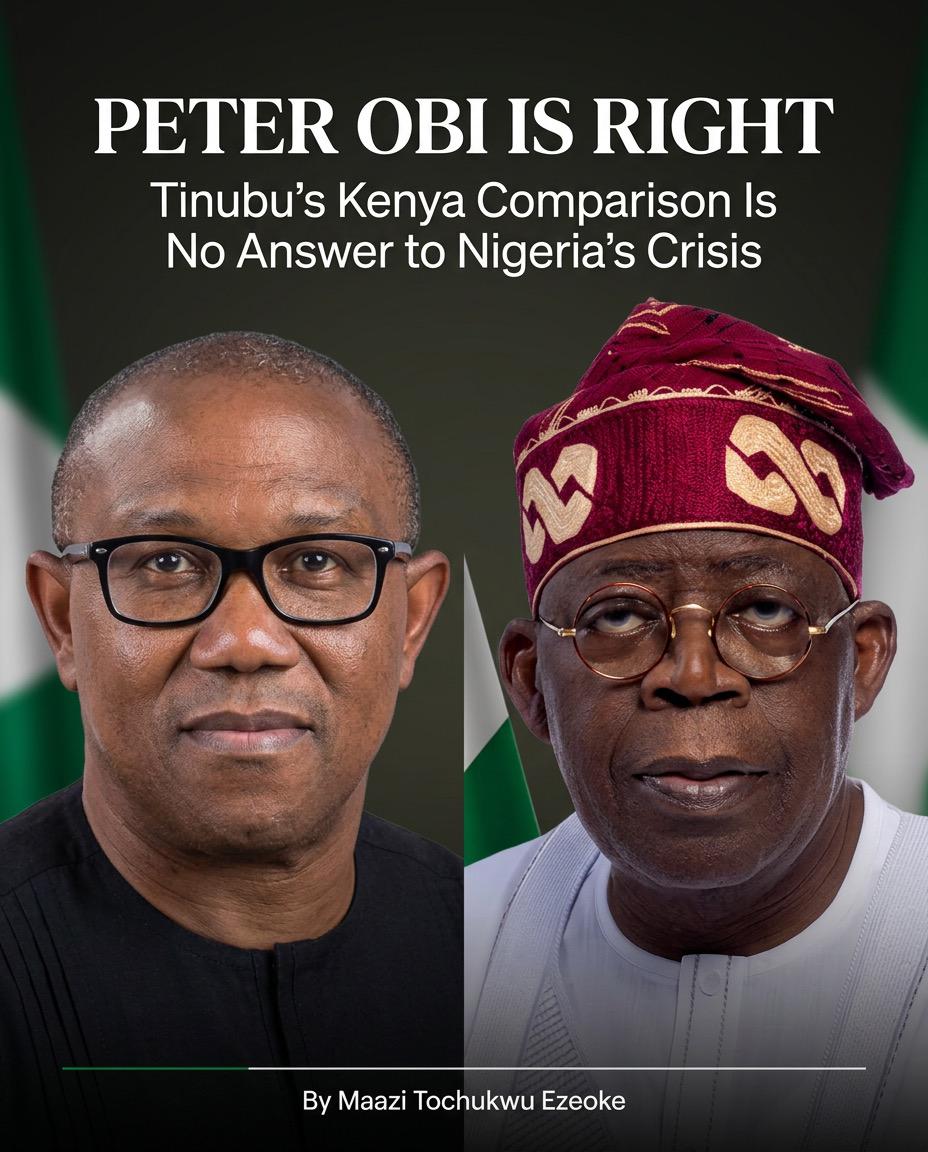
Peter Obi Is Right: Tinubu’s Kenya Comparison Insults Nigerians’ Intelligence
By Maazi Tochukwu Ezeoke, the Village Headmaster.
President Bola Ahmed Tinubu’s suggestion that Nigerians should find comfort in being supposedly better off than Kenya and some other African countries is not merely an unconvincing political line; it is an admission of how drastically this administration has lowered the standard of governance. It is the language of a government that appears to have run short of answers and now seeks shelter in selective comparison instead of measurable progress.
Peter Obi is right to reject that logic. A hurting nation does not need emotional consolation from power. It needs truth, competence, and the kind of leadership that confronts hardship honestly rather than decorating it with rhetoric.
The real issue is not comparison itself. Serious governments compare. They compare growth rates, inflation, poverty, electricity access, life expectancy, education outcomes, and security indicators because data is how nations judge whether policy is working. The real problem is unserious comparison, comparison stripped of context, rigor, and empirical honesty; comparison used not to improve performance, but to excuse failure.
That is why the old dismissive line, “Na statistics we go shop?”, remains one of the most revealing statements in Nigeria’s recent political history. It reflected a disdain for evidence, as though numbers were irritants rather than instruments of accountability. Yet statistics are not luxuries. They are the numerical expression of lived reality. They show whether citizens are eating better, living longer, learning more, earning more, and living in greater safety.
And on those terms, the Kenya comparison does not rescue Tinubu. It embarrasses him.
Take income per head, one of the clearest measures of how much economic output translates into individual welfare. Nigeria’s GDP per capita in 2024 stood at about $1,084, while Kenya’s was roughly $2,132, almost double Nigeria’s figure. So even if Nigeria boasts a larger aggregate economy because of its huge population, the average Kenyan still enjoys a far higher level of economic output per person than the average Nigerian. That is not a talking point in Tinubu’s favour. It is a flashing warning sign.
Inflation makes the contrast even more devastating. In 2024, Nigeria’s inflation rate climbed to about 33.2 percent, while Kenya’s was around 4.5 percent. That difference is not technical; it is brutally human. It means the Nigerian worker, trader, civil servant, pensioner, and small business owner faces a far more savage erosion of purchasing power than his or her Kenyan counterpart. In plain language, the naira in the pocket of an ordinary Nigerian is losing value at a pace that makes daily life feel like punishment.
Life expectancy tells a similarly painful story. Nigerians today are expected to live about 55 years on average; in Kenya, the figure is around 64 years. A gap of roughly nine years is not minor. It reflects deep structural failures in healthcare, nutrition, sanitation, household income, maternal care, and general quality of life. A government under which citizens live shorter lives than those in a peer African country should not be speaking in tones of self-congratulation.
Electricity, that most basic requirement for modern productivity, also exposes the emptiness of the comparison. Around 76 percent of Kenyans have access to electricity, compared with about 61 percent of Nigerians. In a country that endlessly proclaims itself the “giant of Africa,” millions still live and do business in darkness. The result is predictable: higher production costs, weaker industrial output, lower competitiveness, collapsing small businesses, and households forced to spend scarce income on generators and fuel.
Then there is human development, the broader measure that combines health, education, and income. Nigeria’s Human Development Index stands at about 0.560, placing it around 164th out of 193 countries. Kenya performs better on that scale. That matters because HDI is not propaganda and not sentiment; it is a composite snapshot of whether a state is actually expanding the capabilities of its people. On that front, Nigeria remains far below where a country of its resources and ambitions should be.
Security, perhaps the most important responsibility of any state, is where the self-congratulatory comparison becomes almost obscene. Nigeria is ranked the fourth most terrorised country in the world. In 2025 alone, terrorism-related deaths reportedly rose by 46 percent to about 750. This is not the profile of a country that should be comparing itself downward for relief. It is the profile of a country in urgent need of sober leadership. Farmers cannot farm freely, travellers cannot move confidently, communities live under threat, and investors see risk before they see opportunity.
Even on intentional homicide, the difference is grim. Nigeria records about 16 homicides per 100,000 people, compared with roughly 5 per 100,000 in Kenya. A state that cannot guarantee life, liberty, and safe movement has failed at the first principle of governance. Everything else, investment, schooling, productivity, tourism, agriculture, comes after security.
This is why Peter Obi’s criticism strikes such an important moral and intellectual note. His point is not that Kenya is paradise or that other African countries do not face serious challenges. His point is simpler and more devastating: leadership must never weaponise weak comparison as a substitute for performance. A responsible president does not tell suffering citizens to feel better because someone else may also be struggling. A responsible president asks why a country often treated casually in our political rhetoric now performs better than Nigeria on inflation, life expectancy, electricity access, and per capita output.
That is the question this government does not want asked.
Instead, Nigerians are offered narrative in place of policy. They are told to be patient while prices soar, to be hopeful while the currency tumbles, to be resilient while insecurity spreads, and to be grateful while living standards deteriorate. The APC government increasingly speaks as though messaging can replace material governance. But no speech can refrigerate an empty kitchen. No slogan can reduce transport fares. No public relations line can stop a kidnapping. No comparison can disguise a collapsing standard of living.
What makes the Kenya remark especially troubling is that it reveals a government now more interested in psychological management than national transformation. It suggests that the presidency believes citizens can be soothed by relative misery rather than served by concrete improvement. That is not statesmanship. That is evasion.
And this is where Peter Obi’s intervention deserves wider hearing, even beyond partisan boundaries. Nations rise not by flattering themselves, but by confronting evidence. Serious leaders do not cherry-pick comparisons to massage public anger. They examine why peers are doing better and what institutional lessons can be learned. Why is inflation dramatically lower there? Why is electricity access higher? Why do citizens live longer? Why is human development stronger? Why does everyday life appear more stable? These are the questions of governance. Everything else is theatre.
The tragedy of today’s Nigeria is that we are governed by men who too often confuse explanation with achievement. They explain away hunger, explain away insecurity, explain away the falling naira, explain away business closures, explain away poverty, and then demand applause for endurance. But suffering is not a policy success. Survival is not prosperity. Endurance is not development.
No country becomes great by constantly asking to be praised for not being the worst. Great nations are built by leaders who are intellectually humble enough to accept bad news, morally serious enough to own failure, and competent enough to change course.
That is the deeper force of Peter Obi’s rebuke. He is insisting that governance must return to evidence. He is insisting that statistics matter because human beings matter. He is insisting that a nation of over 200 million people cannot continue to be governed by slogans, excuses, and comparative self-deception.
If President Tinubu truly believes Kenya is suffering, despite posting stronger numbers on several key development indicators, then he should understand just how severe the Nigerian condition has become. That realisation should produce humility, not spin. It should produce reform, not rhetoric. It should produce urgency, not consolation.
Nigeria deserves a government that treats data as a compass, not a nuisance; a government that answers hardship with policy, not poetry; a government that understands that the duty of leadership is not to manage perception, but to improve reality.
That is why Peter Obi is right. Tinubu’s Kenya comparison is not an argument for progress. It is an argument for why Nigeria desperately needs better governance.
*Maazi Tochukwu Ezeoke*
*_Headmaster, Village Boys Movement_*