
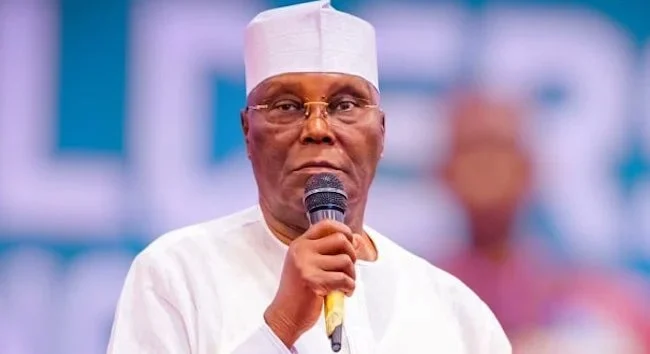
The Independent Media and Policy Initiative (IMPI) has criticised former Vice President Atiku Abubakar’s proposal to restore fuel subsidy if elected president, describing it as a populist policy that could worsen Nigeria’s financial and economic challenges over time.
In a policy statement signed by its Chairman, Dr Omoniyi Akinsiju, the think tank acknowledged that the proposal could initially reduce petrol prices but argued that it could eventually place additional pressure on the country’s finances.
IMPI said: “This reckless, populist proposal represents a dangerous step backwards and a financial trap that would bankrupt Nigeria, destroy the country’s sovereign credit ratings, and wipe out the economic progress made over the past three years.
“Atiku’s proposal to re-regulate prices not only directly undermines the Petroleum Industry Act (PIA) 2021, but also creates an illusion of price reduction.
“Fixed price caps remove commercial incentives for marketers to distribute fuel to remote areas; consequently, fuel supplies would shift to high-volume urban markets like Lagos, Abuja, Kano, and Port Harcourt.”
The organisation said the proposal could also worry international investors because it may indicate a return to regulated petrol prices after more than three years of efforts by the Federal Government to deregulate the downstream petroleum sector.
Atiku’s proposed economic recovery plan calls for replacing consumption subsidy with production subsidy, under which local refineries would receive crude oil at discounted prices so they can sell refined products more cheaply to consumers.
IMPI, however, argued that the arrangement could introduce uncertainty for investors if operators were required to follow pricing structures determined by political considerations.
According to Akinsiju, eligible public and private refineries would receive discounted domestic crude allocations on the condition that the resulting savings were transferred to consumers.
He described the proposed system as complicated, saying it could force operators, including the Nigerian National Petroleum Company Limited and private refineries, to operate under politically imposed pricing formulas.
“Atiku’s proposal also sends signals to global markets that Nigeria lacks regulatory predictability. This policy shift would scare away international capital and freeze modern Public-Private Partnerships, with repercussions for funding critical legacy infrastructure projects and a damning effect on production and productivity,” he said.
IMPI further maintained that reintroducing petrol price regulation would conflict with the Petroleum Industry Act, which provides a framework for a commercially driven downstream petroleum industry.
Akinsiju said the policy could produce an “illusion of price reduction” by shifting the subsidy burden from direct government expenditure to discounted crude oil allocations.
“Atiku’s proposal to re-regulate prices not only directly undermines the Petroleum Industry Act 2021, but also creates an illusion of price reduction. Fixed price caps remove commercial incentives for marketers to distribute fuel to remote areas; consequently, fuel supplies would shift to high-volume urban markets like Lagos, Abuja, Kano, and Port Harcourt,” he said.
The subsidy debate has resurfaced as Nigerians continue to deal with the consequences of the policy introduced by President Bola Tinubu in May 2023.
Tinubu announced the removal of petrol subsidy during his May 29, 2023 inaugural address, arguing that the system was no longer sustainable.
The policy was followed by significant increases in petrol and transport costs. The PUNCH reported that petrol prices climbed from N175 per litre in May 2023 to about N1,300 by May 2026, representing a 643 per cent increase.
Since then, debate has continued over whether the fiscal savings generated by subsidy removal have translated sufficiently into better living conditions.
The Federal Government has argued that the policy released substantial resources to the three tiers of government. Finance Minister Taiwo Oyedele said subsidy and foreign exchange reforms mobilised N15.8tn for the Federation between June 2023 and December 2025.
Of that figure, N5.43tn accrued to the Federal Government, N6.52tn to states and N3.88tn to local governments. The government clarified that the N15.8tn did not represent funds held in a dedicated account but additional resources mobilised through the wider fiscal system.
IMPI maintained that returning to a subsidised pricing arrangement could recreate the financial pressures associated with the former system.
Akinsiju said Nigeria had previously experienced deductions from oil revenues to finance fuel subsidy before funds reached the Federation Account, thereby reducing resources available to state and local governments.
“Atiku’s model repeats this exact pattern. By giving discounted crude oil directly to local refineries, the government creates a massive hidden deduction.
“This directly reduces the revenue flowing into the Federation Account, stripping state and local government leaders of the liquid capital needed to build rural feeder roads, primary healthcare centres, and community water infrastructure,” he said.
The think tank also warned that regulated prices could contribute to fuel shortages in remote communities and create conditions for black markets. It said such outcomes could increase transportation expenses and intensify food inflation, particularly in rural areas.
Instead, it urged the government to prioritise investments that would raise productivity and reduce the structural costs faced by businesses.
“We reiterate that Nigeria’s historical infrastructure deficit cannot be solved by returning to the fiscal policies that created it,” Akinsiju said.
He further argued that Atiku’s proposal could effectively replace direct subsidy payments with a reduction in crude oil revenue.
“Atiku Abubakar’s ‘Follow-the-Barrel’ model replaces a cash subsidy with a crude oil revenue discount. This policy choice risks locking Nigeria back into the same historical cycle: prioritising temporary, popular relief at the pump, while sacrificing the high-quality roads, hospitals, schools, and energy networks required to build a productive national economy,” he said.