
The U.S. Citizenship and Immigration Services (USCIS) has informed a federal court that concerns over unreliable Nigerian documentation and alleged falsification of public records by officials influenced its decision to pause the processing of green card, work permit, and other immigration benefit applications for Nigerian nationals.
In a declaration filed on Friday at the U.S. District Court for the District of Rhode Island, deputy director Angelica Alfonso-Royals defended the agency’s policy of placing applications from Nigerians and citizens of 38 other countries on hold, following entry restrictions tied to terrorism and public safety concerns.
USCIS maintained that it was necessary to “place an adjudicative hold on all pending benefit requests submitted by or for aliens from the high-risk countries” after President Donald Trump’s December 2025 and January 2026 proclamations.
On June 11, District Judge John McConnell struck down the directives, ruling that the administration did not have sufficient statutory or regulatory authority to enforce them.
The agency said it disagreed with the ruling but would resume processing affected applications while considering further legal options.
Ms Alfonso-Royals explained that USCIS screening processes revealed that some previously approved naturalisation and residency applications were based on unreliable information, raising broader vetting concerns.
She added that several affected countries were found to have “little to no credible identity management infrastructure,” making identity verification difficult, alongside issues of corruption and document falsification.
Countries cited included Somalia, Yemen, Afghanistan, Nigeria, Pakistan, South Sudan, Liberia, Ethiopia, Angola, and Sierra Leone.
She stated: “Nigerian documents also have limited credibility due to corruption. In Nigeria, it is common for government officials to falsify records. Furthermore, Nigerian birth and death registrations rarely happen at the time of the event and often only occur when needed, which can be years later.”
She further noted, “Many Nigerian marriage and divorce events are not recorded in formal government databases. When they are, record-keeping is poor to non-existent.”
According to her, USCIS is currently assessing risk profiles for the listed countries and working on measures to reduce fraud risks, including improving access to verification tools and information.
She added that “USCIS is finalising its enhanced vetting plan based upon risk factors present within each country but also based upon screening vulnerabilities identified writ large by gaining access to information and tools not previously available to USCIS,” stressing that the court’s decision hampers efforts to mitigate national security risks.
“As a result, USCIS may miss critical national security, public safety, or integrity concerns that put the American people and the lawful immigration system at risk,” she warned, adding that it could also affect coordination with security and intelligence agencies.
Separately, the report highlighted longstanding concerns about certificate forgery in Nigeria, noting repeated controversies involving public officials and academic records.
One recent case involved Geoffrey Nnaji, former Minister of Science and Technology, who resigned on October 7, 2025, after reports alleged discrepancies in his NYSC and university certificates.
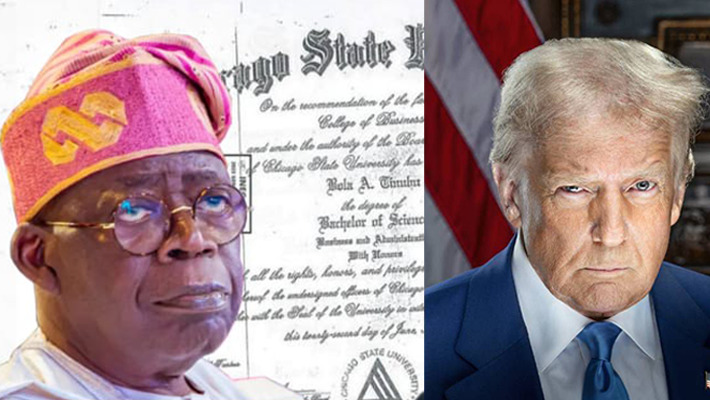
The issue of academic records also surfaced during President Bola Tinubu’s election dispute, when opposition candidate Atiku Abubakar sought access to Chicago State University records over alleged inconsistencies in his credentials, including claims around a female student record linked to his identity.
However, the Supreme Court ultimately dismissed the challenge and upheld Tinubu’s election.
Another notable case referenced was that of former finance minister Kemi Adeosun, who resigned after allegations that she submitted a falsified NYSC exemption certificate during her ministerial screening.