
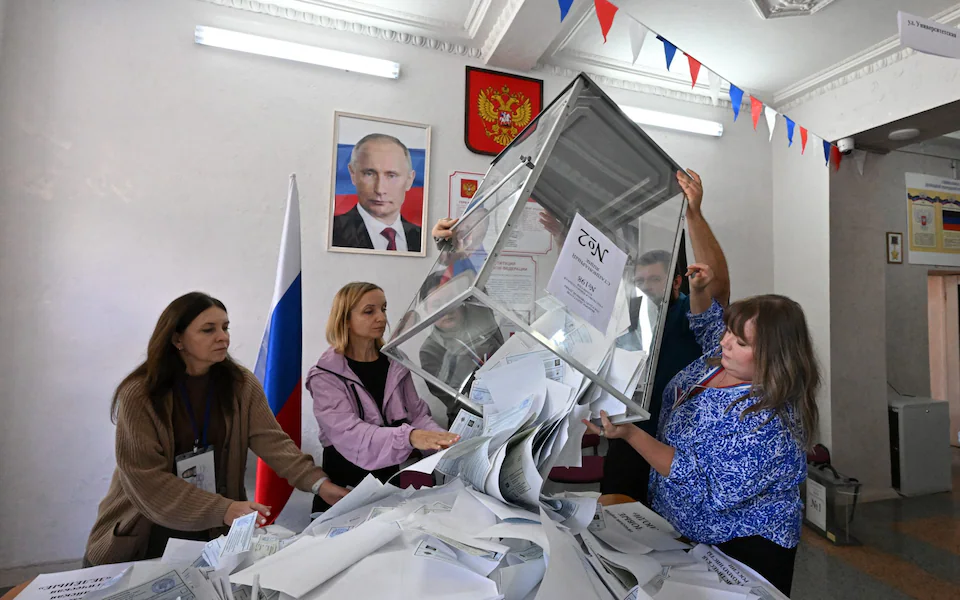
Vladimir Putin’s United Russia party has secured a record number of seats in Russia’s parliamentary election, in a vote that was tightly controlled and excluded most political forces critical of the president.
Preliminary results announced by electoral chief Ella Pamfilova on Monday showed United Russia winning 355 of the 450 seats in the State Duma. The result surpasses the party’s previous record of 343 seats.
The outcome is expected to strengthen Putin’s political control, while concerns have emerged that the election could precede a fresh military mobilisation in Russia. Putin has denied plans for another mobilisation, although Kyiv has accused Moscow of preparing to call up additional troops in the coming weeks.
The election was Russia’s first parliamentary vote since the country launched its full-scale invasion of Ukraine in 2022. Authorities maintained strict controls over the campaign and have prohibited criticism of the military operation.
Most opposition candidates were prevented from participating. Yabloko, described as Russia’s only liberal, anti-war party, was excluded from the party ballot but was permitted to contest individual constituencies.
Several anti-war politicians were also imprisoned or left the country before campaigning began.
According to Pamfilova, voter turnout exceeded 59 per cent, making it the highest turnout recorded in a parliamentary election in more than 10 years. She thanked Russians who participated despite what she described as “psychological pressure” and accused Ukraine of carrying out “more than a thousand” cyber-attacks against Russia’s electronic voting system.
Other parties that routinely support Kremlin-backed initiatives also secured seats. The Communist Party finished second with 40 seats, while the nationalist LDPR won 25 and New People secured 20.
Electronic voting was offered across numerous regions and actively promoted by authorities. Critics argued that the system gave the government greater ability to influence or control the electoral process.
Yabloko and the Communist Party, which has challenged some government policies while avoiding direct criticism of Putin, said several of their election observers were prevented from entering polling stations.
Russia also declined to invite observers from the Organization for Security and Cooperation in Europe (OSCE). The Russian foreign ministry accused the organisation of “double standards” over its criticism of Moscow.
Pere Joan Pons, president of the OSCE Parliamentary Assembly, said Russia’s decision violated its obligations as a member of the organisation.
Images from polling stations showed armed soldiers overseeing voting in some locations.
Pamfilova said more than 95 per cent of ballots had been counted, with the final results expected later in the week.
The election comes amid heightened concerns across Europe over suspected Russian hybrid attacks. Some fear Putin could use the electoral result to justify increased mobilisation, intensify the war in Ukraine or take further action against NATO.
Ukraine has increasingly carried out drone attacks deeper inside Russian territory, adding to pressure on Moscow during the election period.
On Sunday, the final day of voting, hundreds of drones struck Moscow and surrounding areas, killing three people.
Ukrainian President Volodymyr Zelensky said the attacks had damaged one of Russia’s “key oil facilities”.
Russia has responded by installing large anti-drone structures over oil facilities in the capital. Footage appeared to show workers installing extensive layers of giant nets over an oil refinery, with scaffolding supporting the protective structures.