
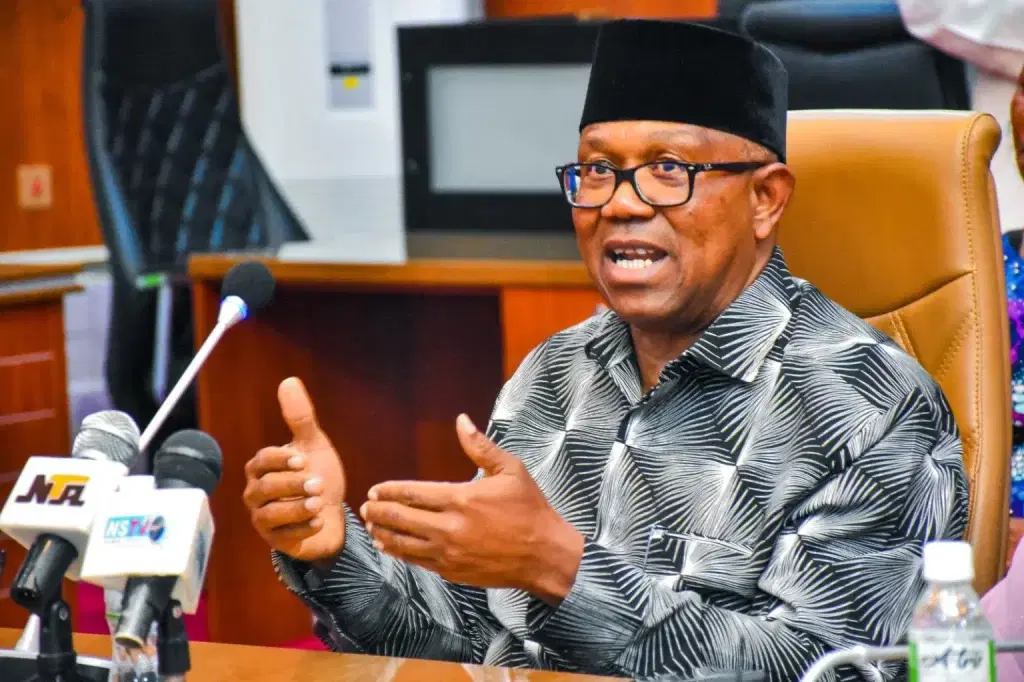
Have you been privileged to work closely with Mr Peter Gregory Obi? Have you been privileged to travel with him across Nigeria by road and air, for official or private engagements? Have you been privileged to share long journeys in the same vehicle with him, discussing national issues, debating ideas and listening to his thoughts without cameras or microphones?
Well, I have been privileged in all the ways listed above. I count myself fortunate for those opportunities because they revealed the real Peter Obi to me. When I describe him as a man who came far ahead of his generation, it is not an attempt to flatter him. It is a conclusion drawn from years of close observation.
There is much about a person that cannot be known from a distance. When you get close enough to Peter Obi, you discover that his public lectures, speeches and interviews are not carefully rehearsed performances. They are reflections of the life he actually lives. His mind is constantly occupied with one question: how can society become better?
He rarely approaches business by asking what he alone will gain. His first question is always what value the venture will add to society. Ironically, it is that philosophy that eventually makes him even more successful because when people genuinely benefit, prosperity naturally follows.
Take NEXT Supermarket, for example. You will hardly find many products sold cheaper elsewhere. Obi negotiates directly with manufacturers, secures the best possible prices and deliberately passes much of that advantage to consumers. Society benefits first through affordability, while the business benefits through high turnover and public trust. That has always been his model.
There are countless private encounters I have had with him that deserve a book of their own. But that book will come at the appropriate time.
In 2017, when his successor, Gov. Willie Obiano, sought a second term, Anambra politics became deeply polarised. Much of Obiano’s first term had been devoted to attacking and discrediting Obi’s achievements. Hundreds of social media operatives were mobilised to spread allegations against the very man who had played a decisive role in making Obiano governor.
Rather than engage in a public war of words, Obi chose restraint. His overriding concern was that Anambra should continue moving forward. Years later, during his interview on Channels Television, some of the questions put to him by Seun Okinbaloye echoed many of those old allegations, including claims that he built no schools and created special examination centres.
Current attacks against him by paid agents of this government, and even by some within fellow opposition parties, follow the Obiano-era pattern: allegations upon allegations, repeated until some begin to mistake repetition for truth.
Take, for instance, the bizarre accusation that Obi profiled and chased Northerners out of Anambra State. Anybody making such an accusation, or believing this fallacy, does not know Peter Gregory Obi. His mind does not accommodate planning or dishing out evil against another human being, irrespective of race, ethnicity or religion.
That is why he does not insult people, no matter how deeply provoked he may be. His thoughts are occupied with making any society he finds himself in better. That is why he discusses issues rather than people. He challenges ideas rather than attacking personalities.
When you get close to him one-on-one, ask him why he does things his way. Ask him, for instance, why he returned Anambra schools to the churches. Ask him why, even after acquiring the vast expanse of land for an airport project, he decided not to embark on one. Ask him why he constructed numerous rural roads that some people mockingly described as roads leading to “nowhere”. Ask him why he chose to save part of Anambra State’s funds in dollars.
The answers to these questions reveal something deeper about the man: he thinks beyond the immediate applause. He thinks about sustainability, value and the long-term interests of the people. His decision to save part of Anambra State’s funds in dollars, for instance, reflected a mind that was not merely planning for the next budget cycle, but preparing for the future. His vision of building 1,000 Small and Medium Enterprises (SMEs) in Anambra by 2030, sixteen years after leaving office, further demonstrated that his thinking was never confined to the period in which he occupied office.
He understood a simple but profound principle: a wise leader does not live only for today; he plants today for the harvest of tomorrow. The greatest proof of responsible leadership is not what one achieves for immediate applause, but what one deliberately puts in place for people one may never meet and generations one may never live to see. What may have appeared strange to some at the time now deserves a much more serious examination.
This is why proximity to Peter Obi matters. When you listen to him privately, away from the microphones and political theatre, you begin to understand that many of the decisions people criticise today were driven by calculations about tomorrow. He may not always explain them in the language politicians use, but there is usually a reason behind them.
And this is precisely why I believe Nigeria stands to benefit enormously if Mr Peter Gregory Obi becomes President of the Federal Republic of Nigeria. The presidency requires more than popularity. It requires the capacity to think beyond the next election, to make difficult choices today for the benefit of generations yet unborn, and to put public interest ahead of personal gratification.
Knowing him well explains why I remain unmoved whenever I encounter sweeping accusations against him. There are some truths that only proximity can reveal. Character is one of them.
In life, reputation can be manufactured, popularity can be purchased and propaganda can dominate headlines for a season. But character has no shortcut. It is built quietly, one decision at a time, one sacrifice after another, until it becomes a way of life.
That is why history ultimately separates those who merely occupied office from those who honoured it. For in the end, a person’s greatest legacy is not the power they held, the wealth they accumulated or the applause they received. It is the integrity they preserved when nobody was watching.
Mr Peter Gregory Obi came far ahead of his generation. Nations rise when they finally recognise such people before it is too late. A POssible New Nigeria depends on that choice.
Obasi writes for PO Express Media, POEM.
Follow us on X https://x.com/obi_media and Facebook https://www.facebook.com/share/1DyfgdmFNA/