
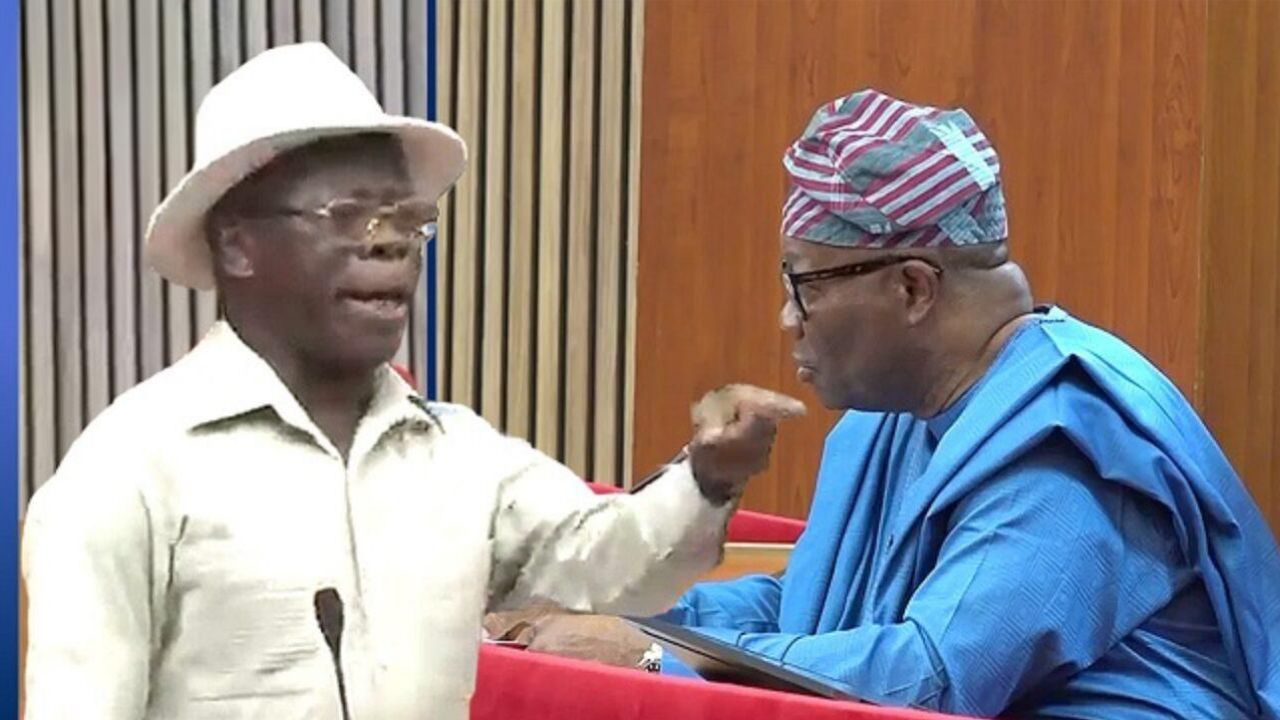
Senate President Godswill Akpabio and Senator Adams Oshiomhole, who represents Edo North, were involved in a heated exchange on Wednesday, just a day after the Senate altered its standing rules to tighten eligibility for presiding offices.
Trouble began when Akpabio started reading the Votes and Proceedings from Tuesday’s sitting. The disagreement briefly disrupted plenary for about 10 minutes.
Oshiomhole attempted to raise a point of order, but Akpabio ruled him out, saying such interventions are not allowed at that stage under the Senate Standing Orders 2023 (as amended).
When Oshiomhole insisted, Akpabio called on former Chief Whip Senator Orji Kalu for clarification. Kalu reportedly confirmed that points of order are not permitted during consideration of Votes and Proceedings.
Despite the explanation, Oshiomhole continued to object, prompting Senate Whip Senator Tahir Monguno to caution him and warn that disciplinary action could be taken if he persisted.
Akpabio then continued the session, directing lawmakers to pages 194 and 195 of the Votes and Proceedings while stressing the need to understand the rules.
“We should not just go home, buy forms and come here without knowing the rules,” he said.
The Senate President also issued a direct warning to Oshiomhole over his conduct.
“Oshiomhole, if you become unruly, we will use the rules to take you out of the Senate,” Akpabio said.
The session later continued without further disruption, with Senator Adamu Aliero moving for the adoption of the Votes and Proceedings, seconded by Senate Minority Leader Senator Abba Moro.
The confrontation is believed to be linked to recent amendments to the Senate’s standing rules, which introduced stricter eligibility requirements for leadership positions in the 11th Senate.
Following a closed-door session, the Senate amended Orders 4 and 5 of its Standing Rules, tightening eligibility for presiding and principal offices.
Under the revised rules, only senators who have served at least two consecutive terms immediately before nomination are eligible to contest presiding offices. Order 4 also requires nominations to follow ranking, from former Senate Presidents down to second-term senators.
Order 5 similarly restricts principal office eligibility to senators with at least two consecutive terms of service.
The changes effectively bar Oshiomhole and other first-term senators from contesting presiding positions.