

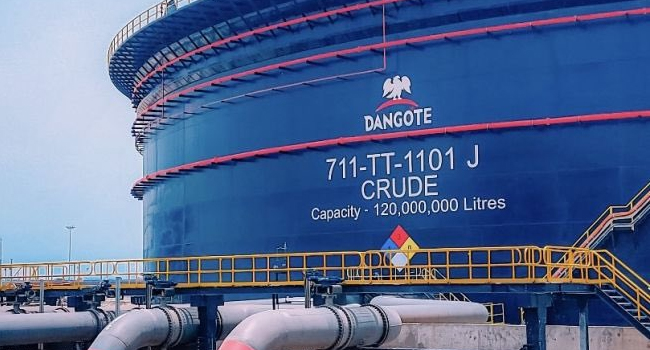
The Dangote Petroleum Refinery has acquired two cargoes of crude oil from the United Arab Emirates, marking the first time it has sourced crude from the Middle East as it broadens its supply base in response to ongoing domestic crude shortages.
A report by S&P Global Commodity Insights stated that the two cargoes are the first Middle Eastern crude purchases for the 700,000 barrels per day refinery, representing a departure from its previous dependence on Nigerian, other African, and United States crude grades.
According to the report, the purchases came after crude exports from the Middle East resumed following an interim peace agreement between the United States and Iran, which restored confidence in shipping through the Strait of Hormuz.
Although the refinery was built mainly to process Nigeria’s light sweet crude, it has been expanding the variety of crude grades it uses as production increases. S&P Global noted that a supply agreement with the Nigerian National Petroleum Company guarantees between 13 and 15 cargoes of Nigerian crude each month in naira, reducing the refinery’s reliance on foreign exchange.
Despite this arrangement, limited crude availability and operational challenges at export terminals have affected supplies. The report recalled that Dangote Refinery Chief Executive Officer David Bird had earlier said these issues forced the company to source additional crude from outside Nigeria.
S&P Global also noted that the refinery’s planned expansion will significantly raise its crude demand. Dangote aims to increase processing capacity to 1.4 million barrels per day by the end of 2028, enough to refine about 80 per cent of Nigeria’s recent daily crude production.
Speaking earlier this year, Bird said the refinery planned to increase the proportion of heavier crude grades in its feedstock. “We definitely want to heavy up the barrel,” Bird said in April.
He added, “We will be in the crude blending game. So you can easily imagine at 1.4 million b/d we could process 30 per cent Middle Eastern grades on each train.”
S&P Global added that the refinery has continued expanding the range of crude grades it processes as it pursues its goal of operating as a fully merchant refinery. The report said that in 2025, about 70 per cent of the refinery’s crude imports came from Nigeria, while 24 per cent were sourced from the United States.